What is multichannel selling? A guide for retailers
TL;DR:
- Multichannel selling involves operating multiple independent sales platforms with separate inventories and customer data. Most retailers should start with two channels and use centralized management to handle inventory, orders, and margins effectively. Operational infrastructure is essential to prevent issues like overselling and margin erosion, ensuring sustainable multichannel growth.
Multichannel selling is defined as the practice of selling products through several independent sales channels simultaneously, each operating as its own platform with separate inventory and customer data. A retailer might sell through their own Shopify website, an Amazon listing, and a TikTok Shop at the same time, with no shared data between them. 73% of customers use more than one channel during their shopping journey. That figure alone makes multichannel selling one of the most consequential decisions a retail business can make in 2026.
What is multichannel selling and which channels does it include?
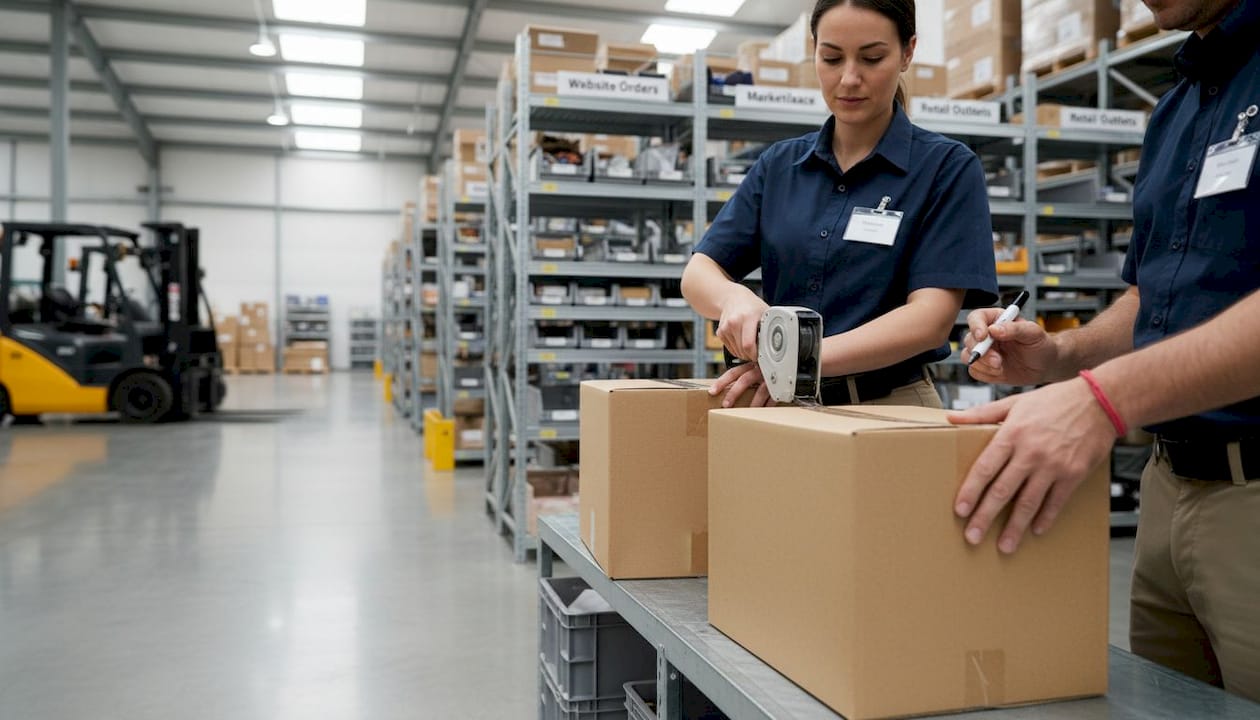
Multichannel selling distributes your product catalogue across independent sales channels, each with its own rules, audience, and data. The most common channels fall into three categories: your own website, third-party marketplaces, and social commerce platforms.
| Channel type | Key benefit | Main challenge |
|---|---|---|
| Own website (e.g. Shopify, Magento) | Full brand control, direct customer data | Requires traffic acquisition investment |
| Marketplaces (e.g. Amazon, eBay) | Large existing audience, built-in trust | Fees, price competition, limited brand control |
| Social commerce (e.g. TikTok Shop, Facebook Shop) | High engagement, impulse purchase behaviour | Algorithm dependency, younger demographics |
Your own website gives you the most control. You own the customer relationship, the data, and the pricing. Marketplaces like Amazon and eBay hand you an audience immediately, but they charge fees and place you next to direct competitors. Social commerce platforms, particularly TikTok Shop, are growing fast with younger shoppers and work well for visually led products.
Multichannel selling platforms vary significantly in how they handle inventory, fulfilment, and reporting. Choosing the right combination depends on where your customers already spend time, not simply where you can list products.
Pro Tip: Start with two channels maximum. Master the operational requirements of each before adding a third. Adding channels without infrastructure in place creates more problems than sales.
What is the difference between multichannel and omnichannel selling?
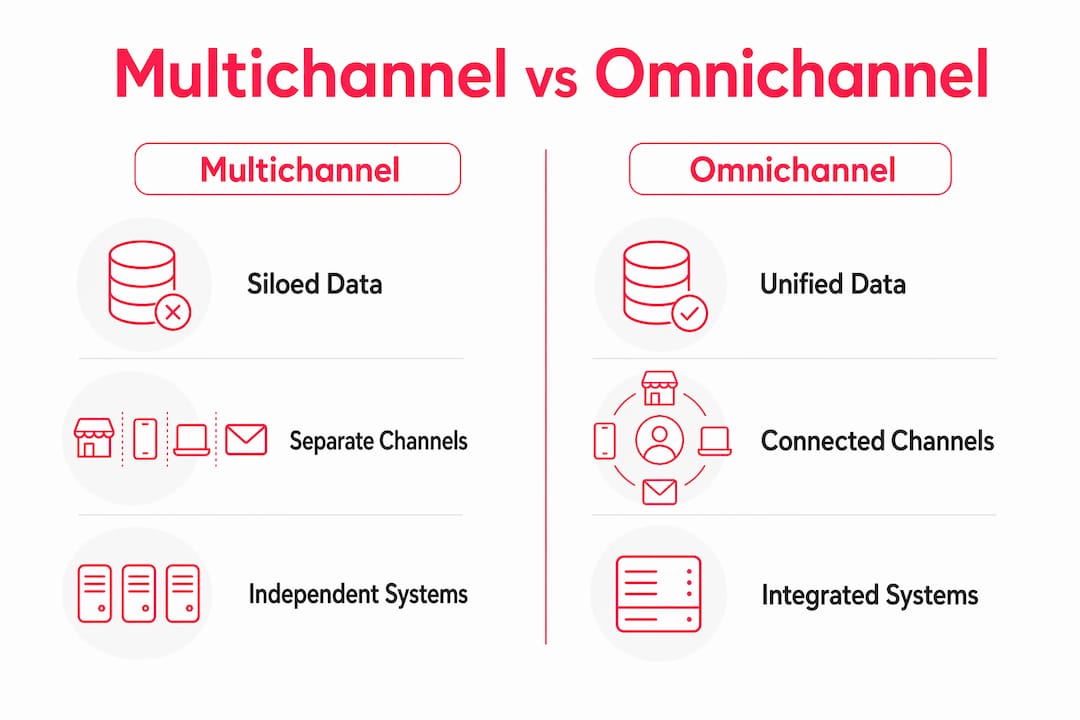
Multichannel and omnichannel are not interchangeable terms, though they are frequently confused. The distinction matters because it shapes your technology investment, your customer experience, and your operational model.
Multichannel keeps data siloed, meaning each channel holds its own customer records, order history, and stock levels independently. Omnichannel, by contrast, connects all channels into a single ecosystem where customer and inventory data flows in real time.
| Factor | Multichannel | Omnichannel |
|---|---|---|
| Data sharing | Siloed per channel | Unified across all channels |
| Customer experience | Consistent per channel, not across them | Consistent across every touchpoint |
| Inventory control | Managed separately per channel | Centralised, real-time visibility |
| Technology investment | Lower initial cost | Higher integration requirement |
| Operational complexity | Moderate | High, but manageable with the right platform |
A practical example illustrates the gap well. A customer browses a product on your website, adds it to their basket, then tries to complete the purchase via your marketplace listing. In a multichannel model, those are two entirely separate journeys with no connection. In an omnichannel model, the basket, the customer profile, and the stock level are shared. Omnichannel connects all channels into a single operating environment, while multichannel runs them in parallel isolation.
For most retail businesses starting out, multichannel is the practical first step. Omnichannel is the destination once the infrastructure is in place. Our guide on omnichannel retail strategy covers that transition in detail.
What are the benefits of multichannel selling for retail businesses?
The core benefit of a multichannel retail strategy is reach. You meet customers where they already shop rather than expecting them to find you on a single platform. Multichannel selling can double traffic and brand visibility, though it does not automatically double margins. That distinction is worth holding onto.
The main advantages are:
- Increased reach. Each channel gives you access to a distinct audience segment. Amazon shoppers, TikTok browsers, and direct website visitors often have little overlap.
- Revenue diversification. Relying on a single channel creates fragility. If one platform changes its algorithm or fee structure, your entire revenue is at risk.
- Customer convenience. Shoppers buy where it is easiest for them. Removing friction from the purchase path increases conversion.
- Cross-channel insight. Selling across multiple platforms generates data on where different customer segments prefer to buy, what price points convert, and which products perform by channel.
- Brand visibility. Appearing on multiple platforms reinforces brand recognition, even when a customer does not purchase immediately.
UK consumers shop across more touchpoints than almost any other global market. That makes multichannel presence not a nice-to-have but a baseline expectation for competitive retail brands. A well-executed multichannel SEO approach compounds these visibility gains further by ensuring each channel feeds organic discovery.
What operational challenges come with multichannel selling?
Each additional channel roughly doubles the administrative burden on your operations team. That is not a reason to avoid multichannel selling. It is a reason to plan for it properly before you launch.
The most common operational problems are:
- Inventory conflicts. Without centralised stock management, the same unit can be sold on two channels simultaneously. Overselling damages customer trust and triggers marketplace penalties.
- Inconsistent pricing. Manual price updates across channels lead to discrepancies. Customers notice, and marketplaces may penalise you for undercutting their platform.
- Order management fragmentation. Processing orders from five different dashboards is slow, error-prone, and expensive in staff time.
- Shipping complexity. Multiple fulfilment locations raise costs and introduce errors. Without a unified logistics strategy, increased sales volume can actually reduce net margin.
- The commodity trap. Selling identical products on marketplaces without a strong direct-to-consumer brand presence invites price wars. Retailers without strong brand channels risk margin erosion as competitors undercut on price.
The solution to most of these problems is the same: centralised middleware or ERP integration that syncs inventory, orders, and pricing across all channels in real time. Manual processes do not scale. A third channel introduced without automation does not add a third of the complexity. It multiplies it.
Pro Tip: Audit your margin per channel before adding a new one. Marketplace fees, fulfilment costs, and returns rates vary significantly. A channel that looks profitable on gross revenue can destroy margin at the net level.
How to implement an effective multichannel selling strategy
A structured approach to implementation prevents the most common pitfalls. Work through these steps before you go live on a new channel.
- Assess your operating margins. Calculate the net margin on your best-selling products after fees, fulfilment, and returns. If the margin is thin on your own website, it will be negative on a marketplace with 15% fees.
- Choose channels based on customer presence. Research where your existing customers actually shop. Survey them, analyse referral traffic, and look at where competitors are active.
- Set up centralised inventory management. Before listing on a second channel, implement a system that syncs stock levels in real time. This is non-negotiable.
- Standardise your product data. Each channel has different requirements for titles, images, and attributes. Build a master product catalogue and map it to each channel’s specification. Multi-store ecommerce platforms handle much of this mapping automatically.
- Automate order routing. Connect all channels to a single order management system so fulfilment is triggered from one place regardless of where the sale originated.
- Monitor performance per channel. Track revenue, margin, return rate, and customer acquisition cost separately for each channel. Cut or adjust channels that do not meet your targets within a defined review period.
- Scale gradually. Add one channel at a time. Prove the operational model works before expanding further.
Effective multichannel selling requires operational transformation, not just marketing expansion. Retailers who treat it as a listing exercise rather than an infrastructure project consistently run into the same problems: overselling, margin erosion, and customer service failures at scale.
Key takeaways
Multichannel selling increases reach and revenue but requires centralised inventory, automated order management, and margin discipline to work at scale.
| Point | Details |
|---|---|
| Definition | Multichannel selling means operating several independent sales channels, each with its own data and inventory. |
| Channel selection | Choose channels where your customers already shop, not simply where you can list products. |
| Multichannel vs omnichannel | Multichannel keeps data siloed; omnichannel unifies it. Omnichannel requires greater technology investment. |
| Operational complexity | Each new channel multiplies complexity. Centralised inventory and order management are prerequisites, not upgrades. |
| Margin discipline | Audit net margin per channel before launching. Marketplace fees and fulfilment costs can turn profitable products into loss-makers. |
The part most retailers get wrong
I have worked with enough retail businesses to say this plainly: the majority of multichannel problems are not marketing problems. They are operational ones.
Retailers get excited about the reach that Amazon or TikTok Shop promises, and they list products before their back-end infrastructure can support the volume. The first month looks great. The second month brings overselling complaints, delayed fulfilment, and negative reviews that take six months to recover from.
The businesses that do multichannel well treat it as an infrastructure project from day one. They invest in centralised inventory management before they need it, not after the first crisis. They audit their margins ruthlessly and accept that some channels simply do not work for their product category or price point.
The other thing I see consistently underestimated is brand dilution. Selling on every marketplace available sounds like diversification. Without a strong direct channel, it is actually a race to the bottom on price. Your own website, built and maintained properly, is the anchor that protects your pricing power everywhere else. The retailers I have seen thrive long-term are the ones who treat their direct channel as the priority and use marketplaces as supplementary reach, not the other way around.
Measured growth, proper tooling, and honest margin analysis. That is the formula. It is less exciting than “sell everywhere,” but it actually works.
— Steve
How Bigeyedeers supports multichannel ecommerce growth
Bigeyedeers has spent over 17 years building and supporting ecommerce platforms for retail brands across the UK. We specialise in Magento and Shopify builds that are designed to handle the operational demands of multichannel selling from the outset.

Whether you need a Shopify build that connects cleanly to marketplace feeds, or a Magento platform with ERP integration and multi-store capability, we build for the complexity that multichannel retail actually involves. We also support inventory synchronisation, order management, and lifecycle marketing through Klaviyo to keep your customer data working across every channel. If you are ready to build a multichannel operation that holds up under real trading conditions, we would be glad to talk.
FAQ
What is multichannel selling in simple terms?
Multichannel selling means listing and selling your products on several separate platforms at the same time, such as your own website, Amazon, and TikTok Shop. Each channel operates independently with its own inventory and customer data.
How does multichannel selling differ from omnichannel retailing?
Multichannel selling runs each channel in isolation, while omnichannel retailing connects all channels into a unified system sharing real-time customer and inventory data. Omnichannel requires greater technology investment but delivers a more consistent customer experience.
What are the biggest risks of multichannel selling?
The main risks are inventory overselling, margin erosion from marketplace fees, and operational complexity that grows faster than revenue. Centralised inventory management and per-channel margin auditing are the most effective controls.
How many channels should a retailer start with?
Start with two channels and master the operational requirements of each before adding more. Adding a third channel without automation in place multiplies complexity rather than simply adding to it.
Do I need special software for multichannel selling?
Yes. Manual management across multiple channels leads to stock conflicts and order errors at scale. A centralised inventory and order management system, or middleware connecting your platforms, is a prerequisite for reliable multichannel operations.
Recommended



Adobe Commerce (Magento)
Formerly known as Magento, Adobe Commerce is built for complex catalogues, integrations, and long term growth. We design and develop stable, scalable stores that support demanding eCommerce requirements, including multi-store setups, complex pricing, and Hyva based performance improvements.

Bespoke Build
We design and build custom eCommerce platforms for businesses with complex workflows, integrations, or non standard requirements. Built from scratch around your business needs using Laravel and modern architectures.
Working with brands across the UK from our offices in Cardiff and Exeter, you deal directly with a senior team of designers and developers specialising in Shopify, Magento, WordPress and bespoke eCommerce platforms.
We focus on commercial outcomes. Better conversion rates, strong SEO foundations and eCommerce platforms that continue to improve long after launch.