What is enterprise UX and why does it matter?
TL;DR:
- Enterprise UX designs software for complex business environments with trained staff, focusing on workflow efficiency and error reduction. Investing in early discovery, compliance, and role-specific interfaces improves adoption, reduces costs, and delivers measurable savings. Organizations should treat enterprise UX as an ongoing process to ensure long-term operational effectiveness and trust.
Enterprise UX is defined as the practice of designing user experiences for complex business software used by multiple roles within large organisations. Unlike consumer apps, enterprise software is mandatory, mission-critical, and operated by trained staff over months or years. The design priority shifts from emotional appeal to workflow efficiency, error reduction, and long-term operational effectiveness. Getting this wrong costs organisations dearly: poor adoption and technical debt follow directly from designs that ignore organisational reality. This guide explains what enterprise UX involves, where it differs from consumer UX design, and how to apply it effectively.
What is enterprise UX and how does it differ from consumer UX?
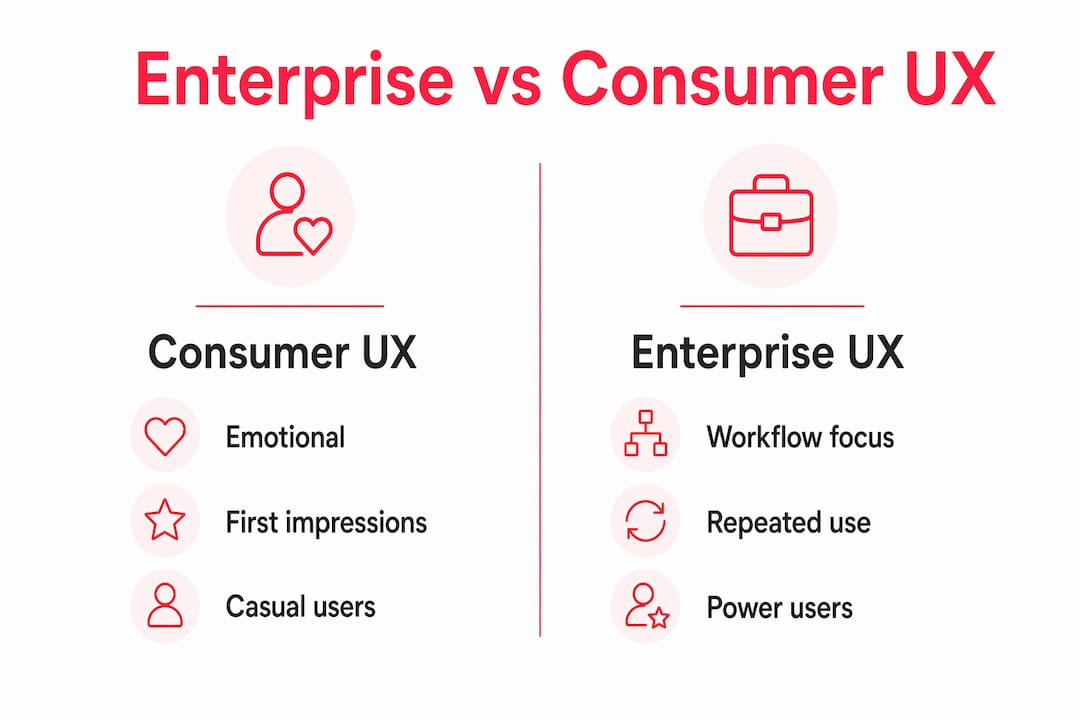
Enterprise UX is the specialised discipline of designing software experiences for business environments where users are trained professionals, not casual visitors. The industry term you will encounter alongside it is “enterprise user experience design,” and both phrases describe the same practice. Enterprise UX prioritises efficiency, error reduction, and long-term effectiveness over emotional engagement. That single distinction reshapes every design decision.

Consumer UX chases first impressions. Enterprise UX optimises the 500th interaction. A consumer app wins if a new user feels delighted within 30 seconds. An enterprise platform wins if a procurement manager can complete a complex purchase order in half the time it took last quarter.
The table below captures the sharpest contrasts:
| Dimension | Consumer UX | Enterprise UX |
|---|---|---|
| Primary goal | Emotional engagement, conversion | Workflow efficiency, error reduction |
| Usage model | Voluntary, short sessions | Mandatory, long-term daily use |
| User type | General public | Trained staff across multiple roles |
| Complexity tolerance | Low | High, by necessity |
| Compliance constraints | Minimal | GDPR, SOC 2, industry regulations |
Role-based access adds another layer of complexity absent from most consumer products. A warehouse operative, a finance director, and a logistics manager may all use the same platform but need entirely different interfaces, permissions, and workflows. Enterprise UX treats software as an operating system accommodating diverse roles and strong data architecture, not a collection of isolated screens. That framing matters because it forces designers to think about the whole organisation, not just individual users.
What are the key challenges in enterprise UX design?
Enterprise UX projects fail more often than they should, and the reasons are predictable. Knowing them in advance is the most practical form of risk management available.
-
Multi-stakeholder misalignment. The people who buy enterprise software are rarely the people who use it daily. Bridging purchaser and end-user needs is the single most common failure point, leading to low adoption and expensive rework after launch.
-
Legacy system integration. Most enterprise environments run on systems built years or decades ago. Designers who assume clean APIs and modern data structures will hit walls fast. Poor integration assumptions, not weak UI aesthetics, are the leading cause of enterprise software failure.
-
Compliance from day one. Requirements including GDPR, SOC 2, and industry-specific standards must be incorporated from the design phase. Compliance is now part of the week-one brief for enterprise UX projects. Retrofitting compliance after build is costly and sometimes impossible.
-
Change resistance. Staff who have used the same system for five years will resist a new interface, even a better one. Change management is not a soft skill here. It is a design constraint that shapes onboarding, terminology choices, and feature rollout sequencing.
-
Discovery scope. Enterprise UX discovery phases typically last 3–12 weeks depending on complexity. Cutting this short to save budget is the most reliable way to guarantee a failed launch.
Pro Tip: Map your stakeholder hierarchy before your first design sprint. Identify who holds sign-off authority, who uses the system daily, and where those two groups disagree. That gap is where your biggest adoption risk lives.
The discovery phase produces validated personas, experience maps, and prioritised opportunity matrices. These are not deliverables for the sake of process. They are the evidence base that keeps design decisions defensible when stakeholders disagree later.
Core principles for effective enterprise UX
Strong enterprise UX rests on a set of principles that differ meaningfully from consumer design best practice. Apply these from the start of any project.
Optimise for power users, not first-timers. Enterprise users are trained professionals who expect to operate complex software over long periods. Rapid-gratification design suited to consumer apps does not serve them. Build efficient shortcuts, keyboard navigation, and batch actions for users who will repeat the same workflows hundreds of times.
Design for multiple roles simultaneously. A single enterprise platform may serve five distinct user types. Each role needs contextual interfaces that surface relevant data and hide irrelevant noise. Role-based access controls are not just a security feature. They are a UX feature that reduces cognitive load for every user group.
Embed compliance and security in the design. Treating GDPR or SOC 2 as a legal afterthought produces expensive retrofits. Compliance requirements shape data display, consent flows, audit trails, and access permissions. These belong in wireframes, not in a post-launch legal review.
Build on evidence, not assumptions. Use research methods including contextual inquiry, task analysis, and workflow shadowing to develop validated user personas. The importance of enterprise UX research is that it surfaces the gap between what stakeholders think users need and what users actually do.
- Conduct contextual interviews with actual system users, not just department heads.
- Map existing workflows before proposing new ones. Understand what works before changing it.
- Prioritise error prevention over error recovery. In high-stakes business processes, a prevented mistake is worth far more than a clear error message.
- Test with representative users across all roles, not just the most vocal stakeholder group.
- Plan for extensibility. Enterprise platforms grow. Design systems and data architecture must accommodate new modules, integrations, and user roles without full rebuilds.
Pro Tip: Use Figma to build a shared component library before any screen design begins. A consistent design system reduces inconsistency across roles and cuts development time significantly when the platform scales.
How does enterprise UX deliver measurable business value?
The business case for investing in enterprise UX is concrete. 50% of organisations achieve approximately 20% cost savings through enterprise UX-driven digital transformation. That figure reflects reduced error rates, faster task completion, and lower support overhead, not abstract design quality.
Adoption rates improve when software fits actual workflows. When they do not, organisations pay twice: once for the build, and again for the workarounds staff invent to avoid using the system properly. Poor adoption also generates technical debt as teams bolt on fixes to compensate for design gaps.
The right KPIs to track enterprise UX success include:
| KPI | What it measures |
|---|---|
| Task completion rate | Whether users can finish key workflows without errors |
| Time on task | Efficiency gains from improved interface design |
| Error rate | Frequency of user mistakes in critical processes |
| System adoption rate | Percentage of intended users actively using the platform |
| Support ticket volume | Reduction in help desk load after UX improvements |
Continuous improvement frameworks matter here. Enterprise UX is not a one-time project. Platforms evolve, regulations change, and user roles shift. Building a feedback loop using analytics, periodic usability testing, and structured user interviews keeps the platform aligned with operational reality. The UX role in SEO and organic growth also compounds over time as better-performing platforms attract and retain more users. Organisations that treat enterprise UX as an ongoing programme rather than a launch deliverable consistently outperform those that do not.
Key takeaways
Enterprise UX succeeds when it treats software as an organisational operating system, not a consumer product, and embeds compliance, role complexity, and workflow research from the very first week.
| Point | Details |
|---|---|
| Enterprise UX is distinct from consumer UX | It prioritises workflow efficiency and error reduction over emotional engagement or first impressions. |
| Compliance belongs in week one | GDPR, SOC 2, and industry standards must shape design from the start to avoid costly retrofits. |
| Discovery phases are non-negotiable | Validated personas and experience maps from 3–12 week discovery phases prevent low adoption and technical debt. |
| Power users need different design | Build shortcuts and batch actions for trained staff who repeat workflows daily, not for first-time visitors. |
| Measurable ROI is achievable | Half of organisations report approximately 20% cost savings from enterprise UX-led digital transformation. |
Why enterprise UX needs a different mindset entirely
The most common mistake I see organisations make is hiring a consumer UX team and pointing them at an enterprise problem. The outputs look polished. The wireframes are clean. And then adoption falls flat six months after launch.
Enterprise users are not sovereign customers. They cannot choose a competitor’s product if they dislike the interface. That changes the entire design contract. Consumer UX earns loyalty through delight. Enterprise UX earns trust through reliability, speed, and the absence of friction in high-stakes tasks.
The purchaser-to-end-user gap is the issue I come back to most often. A procurement director signs off on a platform. The warehouse team uses it 40 hours a week. Those two groups have almost nothing in common in terms of what they need from the software. When design teams only interview stakeholders with budget authority, they build for the wrong person every time.
My honest recommendation: get compliance and IT security into the room during the discovery phase, not after the prototype is built. I have seen projects lose three months of build time because a data display decision made in week two violated GDPR requirements that nobody flagged until legal review. That is entirely avoidable. Improving enterprise UX starts with asking harder questions earlier, not with better visual design.
— Steve
How Bigeyedeers approaches enterprise UX for complex digital platforms
Bigeyedeers works with growing and enterprise retail brands to design, build, and support platforms where UX is not an afterthought. We use Figma to plan user journeys, wireframes, and interface systems before a single line of code is written. That process keeps decisions clear and delivery efficient.
For organisations running complex ecommerce operations, our Magento web design service covers everything from multi-role account hierarchies and tiered pricing to ERP integrations and multi-store setups. We also deliver Shopify builds for brands that need a faster path to a high-performing, well-designed platform. If your current platform is creating friction for your team or your customers, we should talk.
FAQ
What is enterprise UX in simple terms?
Enterprise UX is the design of user experiences for complex business software used by trained staff within organisations. It prioritises workflow efficiency and error reduction over visual appeal or emotional engagement.
How does enterprise UX differ from standard UX design?
Standard UX design often targets first-time or casual users and focuses on onboarding simplicity. Enterprise UX targets trained professionals who use software daily and need efficient, role-specific workflows rather than guided introductions.
Why does compliance matter so much in enterprise UX?
Compliance requirements including GDPR and SOC 2 affect data display, access permissions, and audit trails. Incorporating these from the design phase prevents costly retrofits and legal risk after launch.
How long does an enterprise UX discovery phase take?
Discovery phases for enterprise UX projects typically last 3–12 weeks depending on the complexity of the organisation, the number of user roles involved, and the scale of legacy system integration required.
What ROI can organisations expect from enterprise UX investment?
Half of organisations that invest in enterprise UX-driven digital transformation report approximately 20% cost savings, driven by reduced error rates, faster task completion, and lower support overhead.
Recommended



Adobe Commerce (Magento)
Formerly known as Magento, Adobe Commerce is built for complex catalogues, integrations, and long term growth. We design and develop stable, scalable stores that support demanding eCommerce requirements, including multi-store setups, complex pricing, and Hyva based performance improvements.

Bespoke Build
We design and build custom eCommerce platforms for businesses with complex workflows, integrations, or non standard requirements. Built from scratch around your business needs using Laravel and modern architectures.
Working with brands across the UK from our offices in Cardiff and Exeter, you deal directly with a senior team of designers and developers specialising in Shopify, Magento, WordPress and bespoke eCommerce platforms.
We focus on commercial outcomes. Better conversion rates, strong SEO foundations and eCommerce platforms that continue to improve long after launch.