What is faceted search? A guide for e-commerce teams
TL;DR:
- Faceted search allows shoppers to filter products using multiple attributes simultaneously, improving discovery. Proper setup reduces SEO risks and boosts conversions by providing relevant, easily navigable results. AI-powered personalisation further enhances long-term customer loyalty and product visibility.
Faceted search is defined as a filtering method that lets shoppers refine a product catalogue by selecting multiple attributes simultaneously, such as size, colour, price, and brand. It is the standard industry term for what many practitioners call “search faceting” or “faceted navigation.” Approximately 43%–45% of e-commerce visitors use the search bar as their primary route through a store, and those shoppers convert at 2–5 times the rate of general browsers. That single statistic explains why faceted search sits at the centre of every serious product discovery strategy. Get it right, and you reduce friction, lift revenue, and give your catalogue the structure it deserves.
What is faceted search and how does it differ from basic filtering?
Faceted search is a multi-attribute filtering system built on top of a product database. Each product carries tagged attributes, such as “material: cotton,” “size: M,” or “colour: navy,” and the search engine surfaces only the products that match every selected tag at once. Basic filtering lets a shopper apply one condition at a time. Faceted navigation lets them stack conditions, narrowing thousands of SKUs to a handful of relevant results in seconds.

The distinction matters commercially. A shopper looking for a navy cotton shirt in size M does not want to scroll through 800 results after filtering by colour alone. Faceted search solves that by treating each attribute as an independent dimension, then intersecting them. The result is a user-friendly navigation experience that mirrors how people actually think about products.
E-commerce managers treat faceted search as a core product discovery tool, not a cosmetic feature. That shift in thinking changes how teams prioritise development budgets and UX audits.
How filter attributes and URL structures work together
Every facet selection generates a URL parameter. A shopper filtering by colour=navy and size=M produces a URL such as /shirts?colour=navy&size=M. Two technical approaches handle this differently.
- URL-based filtering updates the page URL with each selection. Search engines can crawl and index these pages, which creates both an opportunity and a risk.
- AJAX filtering updates the product grid without changing the URL. The experience feels fast, but AJAX without crawlable URLs leaves filtered views invisible to Google entirely.
The safest architecture combines AJAX for UX speed with server-side rendering of canonical URLs for the filter combinations you want indexed. This gives shoppers a snappy interface and gives search engines a clear signal about which pages matter.
Pro Tip: Map your most popular filter combinations in Google Analytics before you build. The top 10–15 combinations are the ones worth rendering as indexable URLs. Everything else can be AJAX-only.
What are the measurable benefits of faceted search for e-commerce?
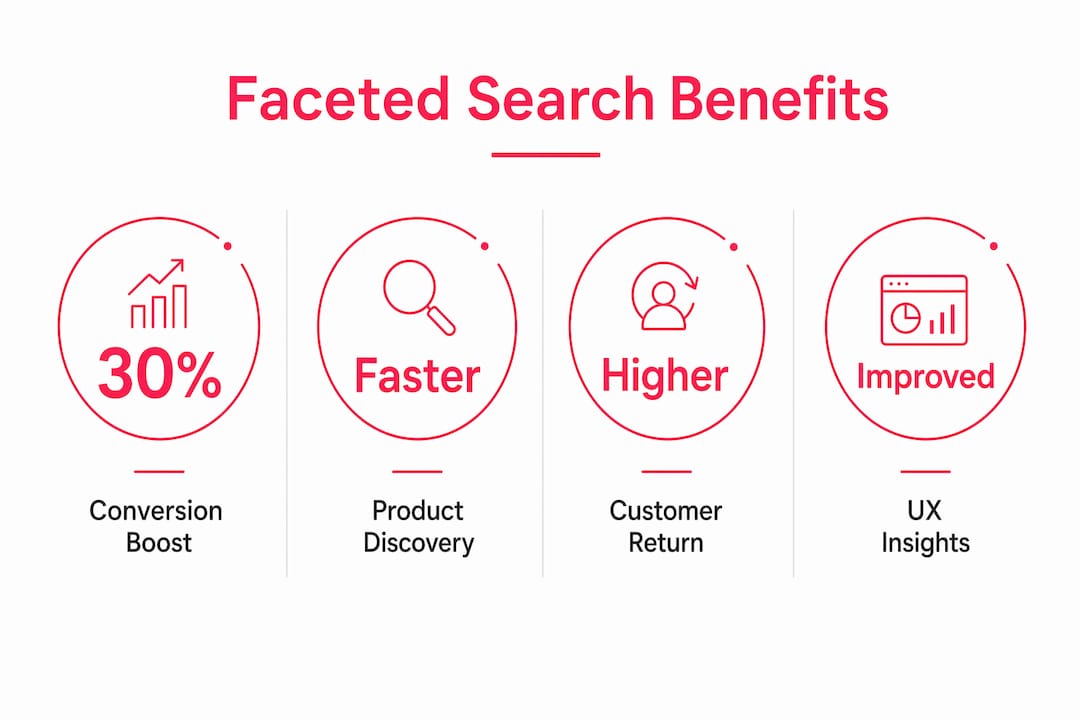
The commercial case for faceted navigation is well established. Stores with optimised faceted navigation can increase conversion rates by up to 30% through reduced friction in product discovery. That figure reflects fewer dead ends, fewer zero-result pages, and a shorter path from intent to purchase.
“Combining autocomplete and search suggestions with faceted filters boosts conversion rates by 17–24% by reducing zero-result queries. Zero-result pages are conversion killers. Pairing faceted filters with live suggestions means shoppers almost never hit a dead end.”
The UX benefits compound over time. Shoppers who find products quickly are more likely to return, more likely to browse additional categories, and more likely to complete a purchase without abandoning their basket. A well-structured faceted system also surfaces long-tail products that would otherwise be buried on page 12 of a flat category listing. That is a genuine revenue unlock for catalogues with deep inventory.
Faceted navigation also feeds your UX improvements for retailers beyond search. When shoppers interact with filters, they tell you exactly what attributes they care about. That data informs merchandising, buying decisions, and promotional planning in ways that session recordings alone cannot.
What SEO challenges does faceted search present?
Faceted navigation creates a crawl budget problem that catches many teams off guard. Four facets with ten options each can generate more than 10,000 URL combinations. Googlebot has a finite crawl budget per site. Wasting it on thousands of near-duplicate filter pages means your core category and product pages get crawled less frequently.
The solution is selective indexing, applied systematically:
- Audit your log files. Compare which filter URLs Googlebot actually crawls against your sitemap. Any filter URL that appears in logs but not in your sitemap is a crawl budget leak.
- Apply canonical tags. For filter combinations that exist but carry low search demand, point the canonical tag back to the parent category page. This consolidates link equity without removing the page for shoppers.
- Use noindex selectively. Selective indexing with canonical and noindex strategies prevents index bloat and link dilution. Apply noindex to parameter combinations that have no realistic search demand.
- Promote high-demand filter URLs. If “navy cotton shirts” generates meaningful search volume, render that filter combination as a clean, permanent page with its own title tag and meta description. Treat it like a landing page, not a filter state.
- Block low-value parameters in robots.txt. Sorting parameters such as
?sort=price_ascand pagination variants rarely deserve indexing. Block them at the crawl level.
| SEO approach | When to use it | Effect |
|---|---|---|
| Canonical tag | Filter combo exists but has low search demand | Consolidates equity to parent page |
| Noindex | Filter combo has no search value | Removes from index, still crawlable |
| Full indexing | Filter combo has clear search volume | Creates a targetable landing page |
| robots.txt block | Sort or pagination parameters | Stops crawl entirely |
Pro Tip: Run a Screaming Frog crawl filtered to URLs containing your facet parameters. Sort by inlinks. Any filter URL with zero inlinks and no search volume is a candidate for noindex or canonical treatment.
How to implement faceted search to maximise product discovery
Effective implementation starts before a single line of code is written. The facet hierarchy, meaning which filters appear first and in what order, should reflect actual shopper behaviour, not internal product taxonomy. A clothing retailer might assume “brand” is the top filter. Analytics often reveal that “size” and “colour” drive far more filter interactions.
Building a facet hierarchy that converts
- Analyse filter interaction data from your current search or navigation logs. Identify which attributes shoppers select first, most often, and in combination.
- Prioritise high-impact facets at the top of the filter panel. Shoppers should not need to scroll to find the attributes they use most.
- Limit the number of visible facets on initial load. Showing 20 filter options at once creates decision fatigue. Show the top 5–6 and collapse the rest behind a “show more” toggle.
- Use real-time filter usage data to refine the hierarchy continuously. What worked at launch may not reflect how your catalogue evolves across seasons.
- Integrate autocomplete with faceted filters. Shoppers who type “running shoes” and then filter by size convert at a significantly higher rate than those who browse category trees alone.
AI-driven personalisation and the 2026 outlook
AI-enhanced faceted navigation personalises filters dynamically based on user behaviour and purchase history, increasing long-term customer loyalty. A returning shopper who consistently buys size 10 trainers in neutral colours should see those facets pre-selected or surfaced prominently. Static filter panels treat every visitor identically. AI-driven panels treat each visitor as an individual.
This is where tools like Klevu, which Bigeyedeers uses across Magento and Shopify builds, become genuinely powerful. Klevu’s merchandising layer sits on top of the faceted system and adjusts result ranking and filter prominence in real time. The examples of AI in e-commerce now extend well beyond product recommendations. Dynamic facet personalisation is one of the most commercially significant applications available to retailers right now.
Balancing UX speed with SEO-friendly URL structures remains the central technical challenge. The 2026 SEO action plan for retailers addresses this directly: render your top filter combinations as static pages, use AJAX for everything else, and audit crawl logs quarterly.
Key takeaways
Faceted search is the single most effective tool for reducing friction between a shopper’s intent and the product that satisfies it, provided the facet hierarchy, URL strategy, and SEO controls are all working together.
| Point | Details |
|---|---|
| Core definition | Faceted search lets shoppers filter by multiple attributes simultaneously, narrowing large catalogues to relevant results. |
| Conversion impact | Optimised faceted navigation can increase conversion rates by up to 30% through reduced product discovery friction. |
| SEO risk | Four facets with ten options each can generate over 10,000 URLs, wasting crawl budget if left unmanaged. |
| SEO fix | Apply canonical tags, noindex, or full indexing selectively based on each filter combination’s search demand. |
| Future direction | AI-driven faceted navigation personalises filter prominence per user, improving loyalty and long-term revenue. |
Why most faceted search implementations fall short
I have reviewed a lot of e-commerce builds over the years, and the pattern is almost always the same. The development team installs a faceted navigation module, maps it to the product attributes already in the database, and calls it done. The filters work. Shoppers can use them. But the hierarchy is wrong, the SEO controls are absent, and nobody is looking at the data.
The uncomfortable truth is that a poorly configured faceted system can actively damage SEO performance. I have seen catalogues where Googlebot was spending the majority of its crawl budget on filter URL combinations that no human would ever search for. Core category pages were being crawled once a fortnight. That is not a minor inefficiency. It is a structural problem that suppresses organic visibility across the entire site.
The other mistake I see regularly is treating faceted search as a set-and-forget feature. Shopper behaviour changes. Catalogues grow. New attributes get added. The facet hierarchy that made sense at launch becomes stale within two seasons. The teams that get the most from faceted navigation are the ones that review filter interaction data monthly and adjust accordingly.
AI-driven personalisation is the next frontier, and it is closer than most teams realise. The gap between a static filter panel and a dynamically personalised one is now a configuration decision, not a custom development project. Retailers who make that move early will hold a meaningful advantage in product discovery for years.
— Steve
Faceted search on Magento and Shopify: how Bigeyedeers can help
Bigeyedeers builds and optimises faceted search across Magento and Shopify for retailers who need product discovery to work harder.
We implement Klevu search and merchandising to give your faceted filters AI-driven intelligence from day one. We also handle the full technical SEO layer, including canonical strategy, crawl budget audits, and selective indexing of high-value filter URLs. Whether you are running a complex Magento catalogue with thousands of SKUs or a growing Shopify store that needs sharper product discovery, we build faceted navigation that converts and ranks. Talk to the Bigeyedeers team to see what a properly configured faceted search system looks like in practice.
FAQ
What is the faceted search definition in simple terms?
Faceted search is a filtering system that lets shoppers narrow a product catalogue by selecting multiple attributes at once, such as size, colour, and price. It is also called faceted navigation or search faceting.
How does faceted search differ from filtered search?
Faceted search and filtered search describe the same core mechanic, but “faceted” specifically implies multiple independent attribute dimensions that can be combined simultaneously. Basic filtered search typically applies one condition at a time.
Does faceted search hurt SEO?
Faceted navigation can harm SEO if filter URL combinations are left unmanaged, as four facets can generate over 10,000 URLs and waste crawl budget. Canonical tags, noindex directives, and selective indexing resolve this.
What are the main benefits of faceted search for e-commerce?
Optimised faceted navigation can increase conversion rates by up to 30% by reducing friction in product discovery and helping shoppers find relevant products faster.
How does AI improve faceted navigation?
AI-enhanced faceted navigation personalises filter prominence based on each shopper’s behaviour and purchase history, increasing the likelihood of conversion and long-term loyalty.
Recommended



Adobe Commerce (Magento)
Formerly known as Magento, Adobe Commerce is built for complex catalogues, integrations, and long term growth. We design and develop stable, scalable stores that support demanding eCommerce requirements, including multi-store setups, complex pricing, and Hyva based performance improvements.

Bespoke Build
We design and build custom eCommerce platforms for businesses with complex workflows, integrations, or non standard requirements. Built from scratch around your business needs using Laravel and modern architectures.

Working with brands across the UK from our offices in Cardiff and Exeter, you deal directly with a senior team of designers and developers specialising in Shopify, Magento, WordPress and bespoke eCommerce platforms.
We focus on commercial outcomes. Better conversion rates, strong SEO foundations and eCommerce platforms that continue to improve long after launch.