Ecommerce replatforming explained: growth strategies for retail
TL;DR:
- Many UK retail brands proactively replatform to improve scalability, speed, and integration capabilities rather than as a last resort.
- A successful replatforming involves careful assessment, platform selection, data migration, testing, and stakeholder communication to ensure a seamless transition.
Many e-commerce managers treat platform migration as a distress signal, something you do when things have gone badly wrong. That’s a costly misconception. The most commercially aggressive UK retail brands are replatforming proactively, using a platform switch as a deliberate lever to unlock faster page speeds, cleaner integrations, and scalability that their current setup simply cannot provide. This guide cuts through the confusion and walks you through the why, the what, and the how of ecommerce replatforming, so you can make a confident, informed decision rather than a reactive one.
Table of Contents
- Defining ecommerce replatforming and when it matters
- Core steps in the replatforming process
- Comparing major ecommerce platforms for UK retailers
- Common pitfalls and expert tips for a seamless transition
- Why ‘set and forget’ is the biggest threat to retail ecommerce
- Take your retail brand to the next level with expert replatforming
- Frequently asked questions
Key Takeaways
| Point | Details |
|---|---|
| Replatforming drives growth | Switching ecommerce platforms can unlock new scale, speed, and capabilities for retail brands. |
| Process needs planning | A well-defined replatforming process helps avoid data loss, downtime, and customer confusion. |
| Choose your platform wisely | Matching your next platform to business needs and future plans is crucial for long-term success. |
| Expert help reduces risk | Working with ecommerce specialists can help you migrate smoothly and avoid costly mistakes. |
Defining ecommerce replatforming and when it matters
Ecommerce replatforming means moving your online store from one technology platform to another. That could mean migrating from WooCommerce to Magento, from a custom-built solution to Shopify, or from Magento Open Source to Adobe Commerce. It involves transferring your product data, customer records, order history, integrations, and front-end design to a new technical foundation.
The misconception we hear most often is that replatforming is a last resort. In reality, the replatforming advantages that retailers unlock are often about growth, not failure. Brands in a growth phase frequently hit structural ceilings on their existing platform: checkout performance degrades under high traffic, custom integrations become expensive to maintain, and the development team spends more time firefighting than building.
Here are the most common triggers that signal it’s time to seriously consider a platform change:
- Performance bottlenecks: Page load times creep up as your catalogue grows, directly impacting conversion rates and Google rankings.
- Integration limitations: Your existing platform can’t connect cleanly with your ERP, PIM, or fulfilment systems, forcing workarounds that create data errors.
- Scalability constraints: Flash sales or peak trading periods cause instability because the platform wasn’t built for your current traffic volumes.
- Developer overhead: Your technical team is spending a disproportionate amount of time patching, maintaining, or rebuilding functionality that a modern platform would handle out of the box.
- B2B complexity: You’re adding wholesale or trade channels that require tiered pricing, account hierarchies, or custom catalogue visibility, none of which your current platform supports natively.
“Replatforming is not about running away from a broken platform. It’s about choosing a foundation that can support where you’re going, not just where you’ve been.”
Understanding which of these triggers applies to your business is the first step. Reviewing the ecommerce platforms for retailers that are genuinely suited to your scale and trading model matters far more than chasing trends. The right platform fit today will save you significant time and money over the next three to five years.
Core steps in the replatforming process
With a clear definition in mind, let’s break down how a typical replatforming journey unfolds for retail brands. It’s rarely as daunting as it first appears, provided you approach it methodically.
-
Strategic assessment. Before any code is written or any data moved, you need clarity on your current pain points, your commercial goals over the next two to three years, and the technical requirements that must be met. This includes understanding your product catalogue complexity, your integration landscape, your B2B or DTC requirements, and your peak traffic patterns. Good planning for ecommerce replatforming at this stage prevents scope creep and budget overruns later.
-
Platform selection. Based on your assessment, you evaluate which platform best meets your needs. This is not purely a features comparison. It includes total cost of ownership, hosting requirements, available extensions, and the depth of the development ecosystem around the platform.
-
Data and content migration. This is arguably the most technically sensitive phase. Product data, customer records, historical orders, CMS pages, URL structures, and metadata all need to transfer accurately. Incomplete or corrupted data migration causes downstream problems that are expensive to unpick. Always run a test migration before the live cutover.
-
Integration and customisation. Most retail brands have a stack of third-party tools: ERP systems, warehouse management platforms, payment gateways, loyalty programmes, and marketing automation tools. Each integration needs to be rebuilt or reconfigured on the new platform. This is also where custom functionality, such as bespoke product configurators or trade pricing rules, gets implemented.
-
Testing and quality assurance. Thorough testing covers functionality, performance under load, payment flow, mobile experience, and data integrity. Many brands underinvest here and pay for it post-launch.
-
Launch and post-launch optimisation. Launching is not the finish line. The weeks following go-live are critical for catching issues, monitoring analytics, and refining the experience based on real user behaviour.
Pro Tip: Schedule your launch window outside your peak trading periods. A Magento migration during the run-up to Black Friday is a recipe for unnecessary pressure. Give your team and your new platform breathing space to stabilise.
It’s worth noting that real-world ecommerce upgrades consistently show that brands who invest adequately in the testing phase see significantly smoother launches and lower post-go-live support costs. Cutting corners at step five always shows up at step six.
Comparing major ecommerce platforms for UK retailers
Once the process framework is in place, the next big question, where to replatform to, needs a grounded answer. There is no universally correct choice. The right platform depends entirely on your trading model, catalogue complexity, technical capability, and growth ambitions.
Here’s a snapshot comparison of the platforms we work with most frequently at Big Eye Deers:
| Platform | Best suited for | Scalability | Customisation | Typical cost profile |
|---|---|---|---|---|
| Shopify | DTC brands, fast growth, leaner tech teams | High (cloud-hosted) | Moderate via apps | Predictable monthly SaaS fee |
| Magento Open Source | Mid-market retailers, complex catalogues | Very high | Extensive | Higher dev investment, lower licence |
| Adobe Commerce | Enterprise retail, B2B/B2C hybrid | Enterprise-grade | Maximum | Premium licence plus dev costs |
| WooCommerce | Smaller retailers, WordPress-native brands | Limited at scale | Moderate via plugins | Lower initial cost, higher long-term overhead |
| Custom build | Unique business models with no platform fit | Variable | Complete | High upfront, bespoke ongoing |
The Magento vs WooCommerce decision is one we’re asked about constantly. WooCommerce works well at lower volumes and simpler catalogue structures, but as you add product variants, trade accounts, and integration requirements, its limitations become apparent. Magento is built for complexity and scales far more predictably.
Shopify is a compelling option for DTC brands that want speed of deployment and low operational overhead. Where it starts to strain is in highly bespoke B2B scenarios, complex multi-store setups, or situations where deep ERP integration is required without compromise.

For brands with genuinely unique requirements, custom ecommerce for retailers remains a viable route, though it comes with the highest long-term maintenance commitment and demands a robust internal or agency-side technical team.
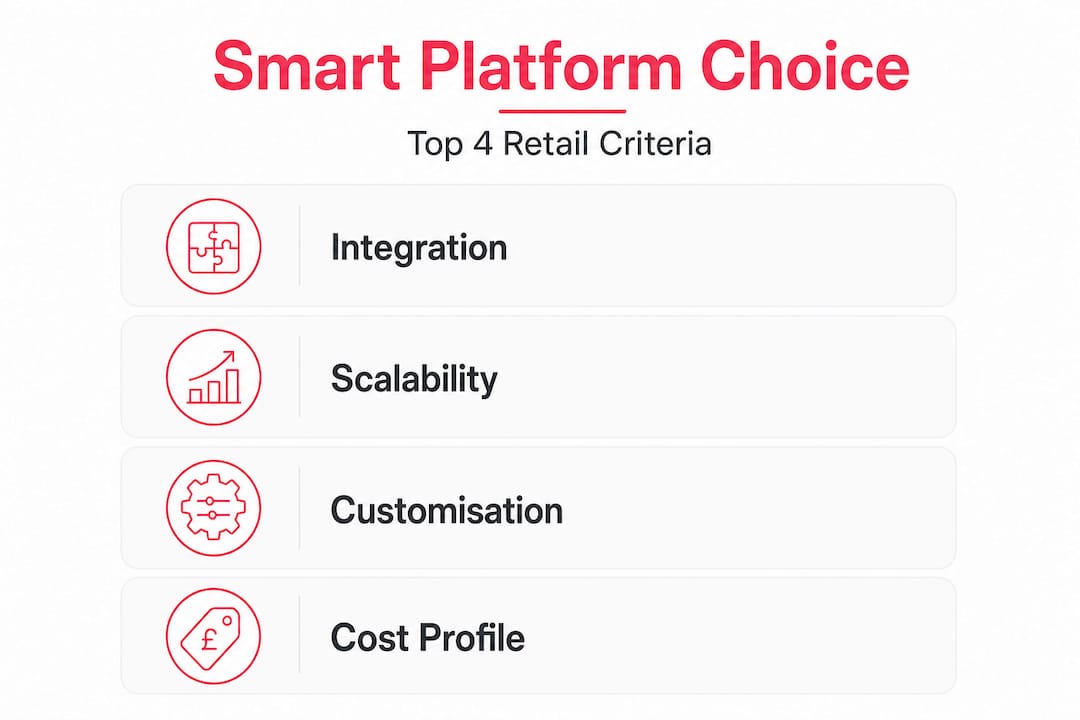
When choosing ecommerce technologies, focus on three criteria above all others: how well the platform integrates with your existing business systems, how much development resource it requires to maintain over time, and how it performs under your peak traffic load. Get those three right and the other decisions become much easier.
Common pitfalls and expert tips for a seamless transition
Understanding what to watch for can be the difference between a costly headache and a springboard for growth. We’ve supported retail brands through enough replatforming projects to know where things tend to go wrong.
The most frequent pitfalls include:
- Underestimating complexity. Brands often scope the visible parts of a migration (product data, design, checkout) and forget the invisible ones (tax rules, customer group logic, promotional pricing, subscription data). The hidden complexity is where budgets blow and timelines slip.
- Inadequate data quality assurance. Migrating dirty data to a new platform doesn’t clean it, it just moves the problem. Run thorough data audits before migration begins, not after.
- Ignoring SEO continuity. URL structures, metadata, canonical tags, and redirect mapping must all be planned before launch. Losing your organic search rankings post-migration can take months to recover from, and for some brands it’s commercially catastrophic.
- Insufficient stakeholder communication. Warehouse teams, customer service staff, and finance need to know what’s changing and when. Surprises on launch day cause operational chaos.
- Skipping user testing. Real users find problems that internal teams miss. Get your actual customers (or at minimum, representative testers) using the staging environment before go-live.
Following best practices for retail replatforming also means building a structured communication plan for both your internal teams and your customers. Transparency about any expected downtime or changes to the checkout experience maintains trust during the transition.
Pro Tip: Before you launch, set up your analytics and conversion tracking on the new platform and verify it’s firing correctly. Launching without confirmed analytics means you’re flying blind during the most important period for spotting and fixing issues.
Cross-team buy-in is genuinely underrated. When the warehouse manager understands why the order management interface is changing, and the finance director understands what the new reporting dashboard can do, adoption is smoother and resistance is lower. Treat the people side of migration as seriously as the technical side.
Looking at retail replatforming case studies from real brand migrations gives you a practical sense of what goes smoothly and what doesn’t. Patterns repeat themselves, and learning from others’ experiences is far cheaper than learning from your own mistakes. For brands working to elevate their visual merchandising alongside a platform move, investing in enhancing ecommerce visuals at the same time can amplify the commercial return on your replatforming investment.
Why ‘set and forget’ is the biggest threat to retail ecommerce
Having explored the mechanics and best practices, it’s time for a frank discussion about the mindset that makes or breaks retail success online.
We see it regularly. A brand invests in a new platform, launches successfully, and then quietly slips into maintenance mode. The platform runs. Orders process. No one questions it. Then, two or three years later, a competitor launches on a faster, more capable platform and starts taking market share. The incumbent brand scrambles to catch up, but their technical debt has compounded, their migration is now more complex, and they’ve lost valuable time.
The uncomfortable truth is that platform inertia is a commercial risk, not a sign of stability. The retail landscape does not reward brands for staying still. Consumer expectations around page speed, personalisation, checkout simplicity, and mobile experience continue to rise every year. A platform that felt cutting-edge in 2022 may already be limiting your conversion rate in 2026.
We’ve worked with brands who delayed replatforming for years because the timing never felt right, the budget was earmarked for something else, or the project felt too disruptive. In almost every case, the delay made the eventual migration more expensive and more complex. The catalogue had grown. The integrations had multiplied. The technical debt had accumulated. What could have been a clean, focused migration became a major undertaking.
Our strong advice: review your platform fit at least annually. Ask whether your current setup is actively enabling your commercial goals or quietly constraining them. Consider whether getting ecommerce right means not just launching well but continuing to evolve your technical foundation as your business grows.
The brands that stay ahead don’t wait for pain. They anticipate it, and they act before it arrives. With future ecommerce innovation moving faster than ever, the cost of inertia is only going up.
Take your retail brand to the next level with expert replatforming
If you’re ready to future-proof your retail store, expert help can make the journey smoother and faster. At Big Eye Deers, we’ve been designing, building, and supporting high-performing ecommerce platforms for over 17 years, and we understand the commercial pressures that UK retail brands face at every stage of growth.
Whether you’re considering a move to Magento, exploring our Magento web design expertise for a complex catalogue build, or evaluating Shopify as a leaner DTC platform, our team brings genuine depth across both. Our Shopify replatforming specialists have delivered projects that reduce time-to-market and improve conversion from day one. We de-risk replatforming through thorough discovery, structured project planning, and honest advice about platform fit. Talk to us about your current setup and where you want to be. We’ll help you find the fastest, most commercially sound route to get there.
Frequently asked questions
What are the main risks of ecommerce replatforming?
The key risks include data loss, unplanned downtime, and a drop in organic search rankings; working with an experienced agency and following structured project planning substantially reduces each of these risks.
How long does an ecommerce replatforming project typically take?
Most retail replatforming projects run from several weeks to a few months, with timeline determined largely by catalogue size, integration complexity, and the thoroughness of your migration planning.
Should I choose Magento, Shopify, or another platform?
The best platform depends on your catalogue complexity, B2B or DTC model, and long-term growth plans; reviewing a detailed platform comparison and getting specialist advice before committing is always worthwhile.
Can replatforming improve site speed and checkout experience?
Yes. Moving to a modern, well-configured platform can deliver significant gains in page load performance and checkout conversion; the advantages of upgrading are well documented across retail brands of all sizes.
Recommended



Adobe Commerce (Magento)
Formerly known as Magento, Adobe Commerce is built for complex catalogues, integrations, and long term growth. We design and develop stable, scalable stores that support demanding eCommerce requirements, including multi-store setups, complex pricing, and Hyva based performance improvements.

Bespoke Build
We design and build custom eCommerce platforms for businesses with complex workflows, integrations, or non standard requirements. Built from scratch around your business needs using Laravel and modern architectures.
Working with brands across the UK from our offices in Cardiff and Exeter, you deal directly with a senior team of designers and developers specialising in Shopify, Magento, WordPress and bespoke eCommerce platforms.
We focus on commercial outcomes. Better conversion rates, strong SEO foundations and eCommerce platforms that continue to improve long after launch.