What is ecommerce middleware? Integration made simple
TL;DR:
- Middleware automates data flow and synchronization across multiple ecommerce platforms.
- It reduces maintenance costs and errors compared to direct API and point-to-point integrations.
- Cloud-based middleware is scalable, cost-effective, and ideal for growing UK ecommerce businesses.
Running multiple ecommerce systems without proper integration is like trying to conduct an orchestra where none of the musicians can hear each other. Orders fall through gaps, stock counts drift out of sync, and your team spends hours each week manually copying data between platforms. It is exhausting, error-prone, and frankly unsustainable as you grow. For UK businesses operating across Magento, Shopify, ERP systems, and third-party marketplaces, there is a smarter path. Middleware sits between your platforms, automates the data flow, and quietly keeps everything aligned so you can focus on trading rather than firefighting.
Table of Contents
- Defining ecommerce middleware and why it matters
- How middleware compares to direct APIs and point-to-point integrations
- Cloud-based middleware vs on-premises: Choosing the right approach
- Ecommerce middleware in action: Magento and Shopify integration
- A better way: What experts wish more UK e-commerce managers knew
- Enhancing your integration journey with expert support
- Frequently asked questions
Key Takeaways
| Point | Details |
|---|---|
| Middleware explained simply | Middleware seamlessly connects your ecommerce tools, automating complex and repetitive tasks so your team can focus on growth. |
| Why middleware trumps APIs | Managing multiple platforms is easier and cheaper long-term with middleware compared to direct APIs or point-to-point links. |
| Cloud offers more flexibility | Cloud-based middleware solutions scale with your business and are easier to update versus on-premises options. |
| Magento and Shopify made easy | Middleware bridges Magento, Shopify, and other tools for unified data and customer experiences. |
Defining ecommerce middleware and why it matters
Now that we’ve put operational headaches front and centre, let’s pin down exactly what middleware does and why it matters to your growing ecommerce business.
At its simplest, middleware is software that sits between two or more applications and manages how they communicate. Think of it as a central switchboard. Instead of your Magento store talking directly to your warehouse management system, your ERP, your Shopify storefront, and your marketplace accounts all at once, middleware handles every conversation in one place. It receives data from one system, transforms it into the right format, and passes it on to the next. No manual re-keying. No missed updates.
The core functions middleware performs for ecommerce operations include:
- Order synchronisation: New orders placed on any channel are automatically pushed to your fulfilment system and ERP without staff intervention.
- Inventory management: Stock levels update across every storefront the moment a sale or returns event occurs, drastically reducing overselling.
- Pricing and catalogue data: Product updates, promotions, and price changes cascade to all connected channels simultaneously.
- Customer data alignment: Shopper records, account histories, and loyalty data stay consistent whether a customer shops on Magento or Shopify.
- Shipping and logistics: Despatch confirmations and tracking numbers flow back to the customer-facing platform automatically.
The business case is compelling. When you understand how ecommerce integration works, it becomes clear why the manual alternative simply does not scale. Mistakes made by manually re-entering data are costly to correct and even more costly to your customer relationships. As middleware reduces maintenance by over 75% when you are running four or more connected systems, the savings compound quickly.
“Middleware is not a luxury for enterprise retailers. It is the operational backbone that lets growing businesses compete without scaling their headcount in proportion to their complexity.”
Pro Tip: Before you choose a middleware tool, map every system that touches your order lifecycle, from your storefront to your courier. You will almost certainly find more touchpoints than you expected, and that map will become the foundation of your integration specification.
Middleware is particularly vital in three scenarios. First, multi-channel retail, where you are selling on your own storefront, Amazon, eBay, and perhaps a wholesale portal simultaneously. Second, international operations, where currency, tax rules, and fulfilment logic differ by region. Third, hybrid platform setups, where you are running Magento for B2B and Shopify for direct-to-consumer, both needing to share the same product catalogue and stock pool.
How middleware compares to direct APIs and point-to-point integrations
With a working definition in mind, it is important to see how middleware is different from the alternatives you might have tried or considered.
Direct API integrations connect one system to another using the platform’s built-in application programming interface. They are fast, technically clean, and perfectly adequate when you only have two systems to connect. The problem appears the moment you add a third or fourth platform. Each new system requires its own bespoke connection to every other system it needs to talk to. Development costs rise steeply, and every time one platform releases an update, your custom code may break and need reworking.
Point-to-point integrations are essentially a collection of direct API connections strung together without central management. For one or two systems, this is fine. But as your stack grows, you end up with a tightly tangled web of interdependencies. When something breaks, identifying which connection failed and why can take days. Upgrading one platform risks disrupting several others. It is a maintenance nightmare that quietly drains development resource and budget.
Here is how the three approaches compare in practice:
| Factor | Direct API | Point-to-point | Middleware / iPaaS |
|---|---|---|---|
| Setup complexity | Low to medium | Medium | Medium to high initially |
| Maintenance at scale | High | Very high | Low |
| Best for number of systems | 1 to 2 | 2 to 3 | 4 or more |
| Development cost over time | Escalates quickly | Escalates significantly | Predictable and controlled |
| Upgrade resilience | Poor | Very poor | Strong |
| Visibility and monitoring | Limited | Very limited | Centralised and clear |
The pattern is obvious. For small, simple stacks, direct APIs do the job. But once your operation grows beyond two or three systems, and most ambitious UK ecommerce businesses do grow that quickly, API adoption in UK ecommerce tends to evolve into a tangled mess without proper orchestration. That is where middleware earns its place.
Typical problems that middleware prevents include:
- Duplicated integration logic that creates inconsistencies when one copy is updated and another is not.
- Upgrade nightmares where a Magento version bump breaks five separate direct connections.
- No single source of truth for order or inventory data, leading to overselling and customer service chaos.
- Slow error detection, where a failed sync is not discovered until a customer complains.
- Developer dependency, where only one or two people understand the integration architecture and your business grinds to a halt when they leave.
As maintenance drops by 75%+ when businesses move to middleware with four or more connected systems, the argument for making the switch is not just technical. It is financial.
Pro Tip: If your development team is spending more than a day each month firefighting broken integrations, that is a strong signal you have outgrown your current approach and middleware should be on your roadmap.
Cloud-based middleware vs on-premises: Choosing the right approach
Once you have decided middleware is the way to go, the next big consideration is how you will host and manage it.
There are two broad categories: on-premises Enterprise Service Bus (ESB) and cloud-based Integration Platform as a Service (iPaaS).
| Criterion | On-premises ESB | Cloud iPaaS |
|---|---|---|
| Infrastructure cost | High upfront investment | Pay-as-you-go model |
| Maintenance responsibility | Internal IT team | Shared with provider |
| Scalability | Requires hardware planning | Scales on demand |
| Implementation time | Months | Weeks |
| Low-code / no-code options | Rare | Common |
| Compliance management | Manual updates required | Often automated |
| Remote access | Complex VPN setup | Native |
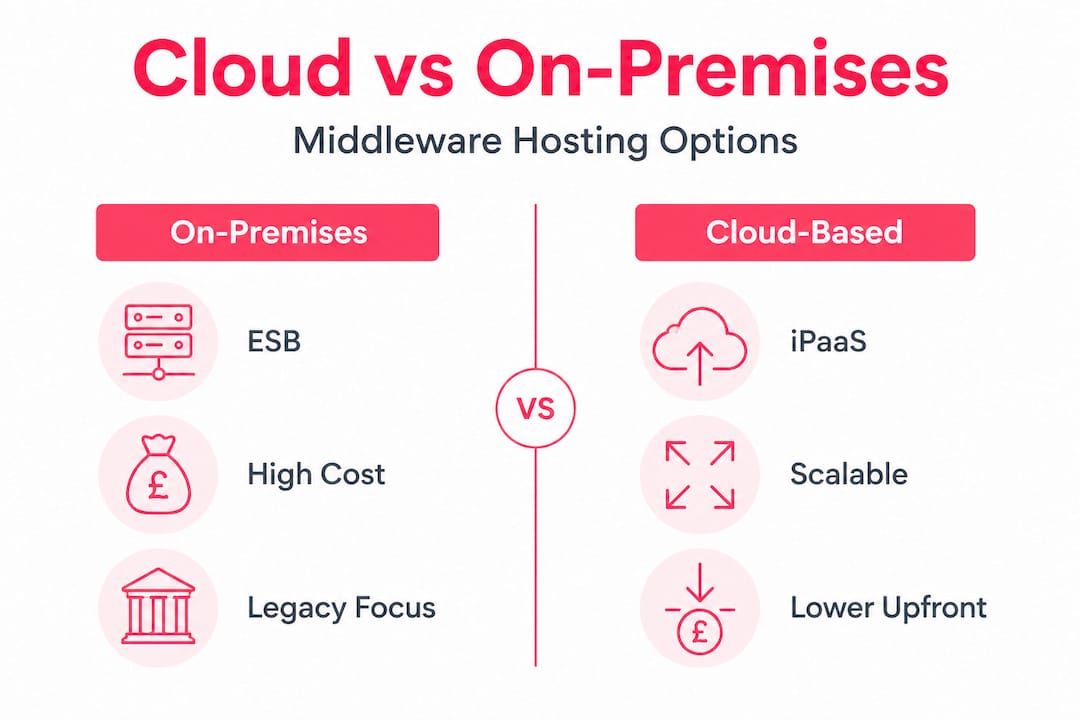
On-premises ESB solutions are best suited to large enterprises with significant legacy infrastructure that cannot be moved to the cloud, strict data sovereignty requirements, or internal IT teams large enough to manage and maintain the middleware layer independently. The investment is substantial but can be justified at genuine enterprise scale with very specific compliance constraints.
Cloud-based iPaaS is, in our experience, the right choice for the vast majority of UK ecommerce businesses. It is scalable, meaning you pay for what you use and expand as your order volume grows. It requires far less internal technical resource to maintain. And critically, compliance updates, such as those related to GDPR or PCI DSS, are often handled at the platform level, reducing your security exposure. For businesses running enterprise ecommerce cloud solutions, cloud iPaaS offers a far more agile and cost-effective foundation.
Popular cloud middleware tools in the UK ecommerce space include:
- Webgility: Particularly well-suited to Magento and Shopify environments, automating accounting, inventory, and order workflows.
- Celigo: A strong choice for businesses with complex ERP integrations such as NetSuite or SAP.
- MuleSoft: Enterprise-grade, with deep customisation options for large and complex operations.
- Patchworks: A UK-based iPaaS provider with strong native connectors for Magento, Shopify, and major ERPs.
- Boomi: Good for businesses needing to integrate both cloud and legacy on-premises systems simultaneously.
As the evidence shows, ESB versus cloud iPaaS is not simply a technical choice. It is a strategic one that affects how quickly you can adapt to market changes, how much your integration layer costs over time, and how dependent your operations are on specialised internal resource.
“Choosing the wrong middleware model is not just a technical problem. It becomes a commercial constraint that limits how fast you can grow, launch new channels, or respond to seasonal demand spikes.”
Ecommerce middleware in action: Magento and Shopify integration
Understanding the different middleware types, let us look at middleware in action, especially for those running hybrid UK storefronts with Magento and Shopify.

This is a genuinely common setup. Many of our clients use Magento for B2B operations, managing complex catalogues, tiered pricing, and account hierarchies, while simultaneously running a Shopify store for direct-to-consumer retail. Without middleware, these two platforms operate in silos. Stock sold on Shopify does not automatically reduce availability on Magento. Orders from both channels need to be manually consolidated before they reach the warehouse. Customer records exist in two separate databases with no link between them.
Middleware resolves all of this. Here are the most impactful workflows that get automated in a typical Magento and Shopify integration project:
- Unified stock pool: A single inventory record shared across both platforms, updating in real time as orders are placed, returned, or restocked.
- Order consolidation: All orders from Magento and Shopify flow into a single ERP or warehouse management system, eliminating manual CSV exports.
- Pricing synchronisation: Promotional pricing or B2B-specific pricing rules apply only to the correct channel, with no risk of a trade price leaking onto the consumer storefront.
- Customer record merging: Shoppers who exist in both systems are identified and deduplicated, giving your marketing and CRM teams a clean data set.
- Shipping and tracking: Despatch events trigger automatic tracking updates on both platforms simultaneously, reducing customer service enquiries.
For UK retailers watching Magento and Shopify trends closely, the shift towards hybrid platform models is accelerating. Cloud iPaaS suits hybrid Magento and Shopify operations particularly well, with tools like Webgility offering pre-built connectors that significantly reduce implementation time and risk.
When you are planning a Magento and Shopify integration project, the key questions to work through before committing to a middleware tool are:
- Which system will hold the master product catalogue, and which will consume it?
- How will you handle SKUs that exist on one platform but not the other?
- What is your conflict resolution rule when stock levels differ between systems at the point of sync?
- Do you need real-time sync, or will a scheduled batch update every fifteen minutes suffice?
- How will you handle returns, and which platform triggers the re-stocking event?
If you are weighing up platform choices more broadly, a comparison of Aero versus Magento versus Shopify gives useful context for understanding where each platform performs best before you commit to an integration architecture.
Pro Tip: Always design your middleware integration around your ERP or warehouse management system as the master record for stock, not your storefront. Storefronts should consume data, not own it. This single principle prevents the majority of sync conflicts we see in poorly designed integrations.
A better way: What experts wish more UK e-commerce managers knew
Having seen how middleware delivers in practice, here is what many integration projects miss, and what we would tell every ecommerce manager before they sign off a budget.
Most UK businesses significantly underestimate the ongoing cost of maintaining direct API and point-to-point integrations. The initial build feels affordable. The real cost arrives twelve months later, when a Shopify API version is deprecated, a Magento upgrade breaks a connector, or a new marketplace channel requires six new bespoke connections. At that point, what looked like a lean technical solution has quietly become a full-time maintenance burden.
Middleware is not just about operational efficiency. It is about building a tech stack that can absorb change without breaking. Retailer priorities shift. New channels open. Platforms release new versions. Your middleware layer should act as a buffer that protects your broader systems from cascading disruption when any one component changes. As integration maintenance drops by 75%+ when businesses standardise on middleware for four or more connected systems, the long-term commercial case is clear.
The pitfalls we see most often in practice:
- Failing to account for system changes: A platform upgrade is not a one-off event. It is a recurring cost that your integration architecture must absorb gracefully.
- Ignoring automation opportunities: Most businesses implement middleware to solve an immediate pain point and then stop. The real value comes from continuously identifying and automating new manual processes.
- Treating middleware as purely technical: The decision about which middleware to use and how to configure it should involve operations, finance, and marketing, not just IT. The automation opportunities span every department.
- Not testing failure scenarios: What happens when the middleware itself goes offline? A robust integration design includes fallback logic and alerting, not just happy-path automation.
Our honest recommendation? Invest in proper ecommerce consulting before you commit to an integration architecture. The cost of getting this right at the design stage is a fraction of the cost of unpicking a poorly designed point-to-point system eighteen months down the line.
Enhancing your integration journey with expert support
If you are managing a growing ecommerce operation and the complexity of connecting your platforms is starting to slow you down, we can help you move forward with confidence.

At Big Eye Deers, we have spent over 17 years building and integrating high-performance ecommerce platforms for UK retailers. Whether you need a Magento integration built from the ground up, a Shopify development project that needs to connect to your existing infrastructure, or expert guidance on how to architect a middleware-led solution that scales with your business, our team in Cardiff and Exeter is ready to help. We bring deep platform knowledge, honest strategic advice, and a track record of delivering complex, multi-channel integrations for growing and enterprise retail brands. Explore our broader ecommerce web design expertise to see what is possible when integration is done properly.
Frequently asked questions
What does ecommerce middleware do?
It connects your ecommerce platforms, automates data transfers, and keeps inventory, orders, and customer information in sync across all your channels. For businesses running four or more systems, middleware reduces maintenance by over 75% compared to traditional point-to-point connections.
Is middleware better than direct API integrations?
Middleware is more cost-effective and scalable for businesses with four or more platforms, while direct APIs may work for simpler, smaller setups. With four or more systems, direct API maintenance costs escalate significantly, making middleware the more commercially sound choice.
How does cloud-based middleware help UK e-commerce?
It offers flexibility, scalability, and easier compliance management for UK businesses running solutions like Magento and Shopify. Cloud iPaaS tools such as Webgility are specifically designed to support hybrid platform environments common in UK retail.
What platforms can ecommerce middleware integrate?
Most middleware tools support all major ecommerce platforms including Magento, Shopify, and WooCommerce, as well as marketplaces such as Amazon and eBay, ERPs, warehouse management systems, and accounting software.
What problems does middleware prevent?
It eliminates manual data entry errors, reduces integration maintenance overhead, and ensures smooth multi-channel growth without proportional increases in IT resource. As point-to-point maintenance costs spiral with each new system added, middleware keeps your stack manageable and your team focused on trading rather than troubleshooting.
Recommended



Adobe Commerce (Magento)
Formerly known as Magento, Adobe Commerce is built for complex catalogues, integrations, and long term growth. We design and develop stable, scalable stores that support demanding eCommerce requirements, including multi-store setups, complex pricing, and Hyva based performance improvements.

Bespoke Build
We design and build custom eCommerce platforms for businesses with complex workflows, integrations, or non standard requirements. Built from scratch around your business needs using Laravel and modern architectures.
Working with brands across the UK from our offices in Cardiff and Exeter, you deal directly with a senior team of designers and developers specialising in Shopify, Magento, WordPress and bespoke eCommerce platforms.
We focus on commercial outcomes. Better conversion rates, strong SEO foundations and eCommerce platforms that continue to improve long after launch.