Magento Open Source explained: flexible eCommerce for UK retailers
TL;DR:
- Magento Open Source offers full ownership and extensive customization for UK retailers.
- It requires technical expertise for maintenance, updates, and hosting management.
- Suitable for mid-sized and large brands with complex needs and growth ambitions.
Magento Open Source gets a reputation it doesn’t quite deserve. Many UK retailers assume it’s either a budget compromise or an impenetrable technical fortress reserved for enterprise teams with deep pockets. Neither is true. What it actually offers is something rarer: genuine ownership of your eCommerce platform, with the freedom to build exactly what your brand needs. This guide breaks down what Magento Open Source really is, how it compares to hosted alternatives, what challenges to expect, and how UK retail brands are putting it to work right now.
Table of Contents
- Defining Magento Open Source: core features and principles
- Magento Open Source versus hosted eCommerce platforms
- Advantages and challenges for growing UK retail brands
- How UK retailers use Magento Open Source in the real world
- Why Magento Open Source may be worth the investment for UK retailers
- Grow your retail brand with Magento expertise
- Frequently asked questions
Key Takeaways
| Point | Details |
|---|---|
| Open-source flexibility | Magento Open Source gives UK retailers full control over their online shop’s design and features. |
| Advanced customisation | You can tailor every aspect of the experience, from checkout to integrations, for unique business needs. |
| Requires technical know-how | Magento Open Source is powerful but demands more technical skill and ongoing maintenance than typical SaaS options. |
| Best for ambitious brands | Medium to large UK retailers with growth plans benefit most from Magento Open Source’s full capabilities. |
| Community-driven enhancements | Regular updates and innovations from a global community keep Magento Open Source adaptable and secure. |
Defining Magento Open Source: core features and principles
With the confusion addressed, let’s clarify exactly what Magento Open Source is and why it matters for retailers.
Magento Open Source is a free, community-driven eCommerce platform written in PHP under the OSL v3 licence, providing core features like catalogue management, checkout, payments, shipping, and extensibility via modules. That last point matters enormously. The OSL v3 licence means you can use, modify, and distribute the software freely, but any modifications you distribute publicly must also remain open source. In practice, most retailers never trigger this clause because they’re building private, proprietary stores.
Out of the box, Magento Open Source gives you:
- Catalogue management: Support for complex product types, configurable products, bundled items, and tiered pricing
- Shopping cart and checkout: A multi-step checkout flow with guest and registered account options
- Payment integrations: Native support for PayPal and Braintree, plus hundreds of third-party payment gateways
- Shipping logic: Custom shipping rules, carrier integrations, and delivery method management
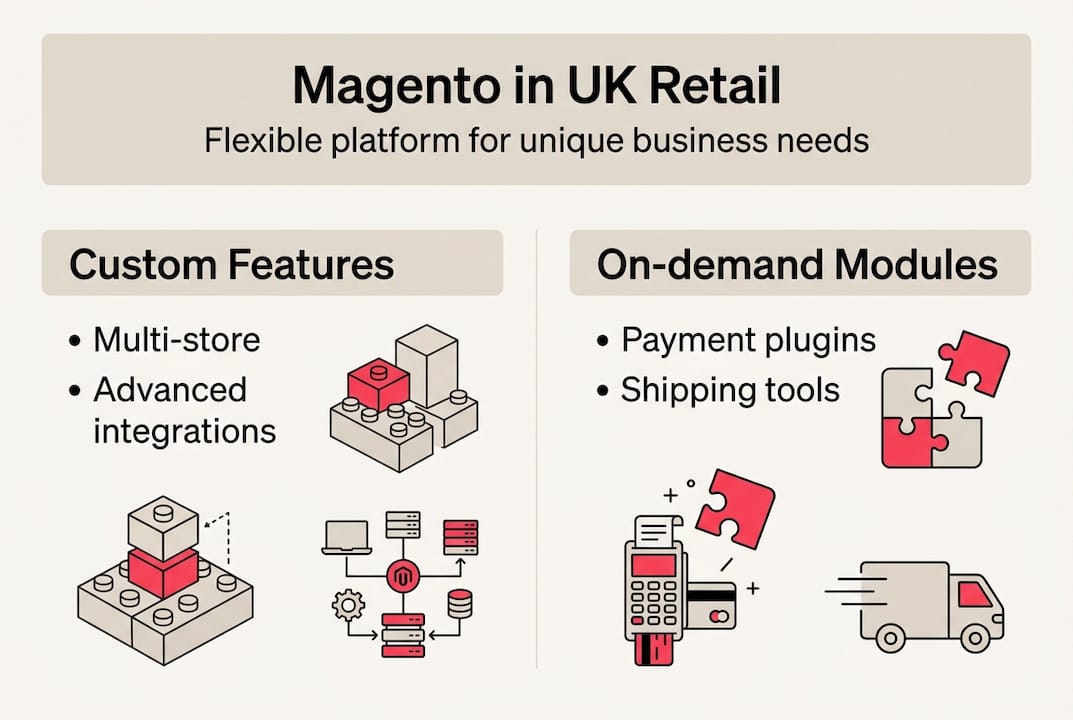
- Multi-store capability: Run multiple storefronts from a single admin panel, with separate languages, currencies, and catalogues
- Extensions marketplace: Thousands of community and commercial modules available to extend functionality
The platform’s modular architecture is where the real flexibility lives. You can add, remove, or override almost any piece of functionality without touching core files. This keeps upgrades cleaner and customisations more maintainable over time.

The global Magento community is vast and active, which translates to regular security patches, peer-reviewed modules, and a rich pool of developer knowledge. That community is a genuine asset, not just a marketing talking point.
Pro Tip: Before buying a premium extension, check the Magento Marketplace reviews and the module’s GitHub repository for recent activity. A module that hasn’t been updated in 12 months may create compatibility problems after your next upgrade. Explore what Magento ecommerce success looks like when the right tools are chosen from the start.
Magento Open Source versus hosted eCommerce platforms
Now that the basics are clear, UK retailers often ask how Magento stacks up to other popular eCommerce choices.
The fundamental difference between Magento Open Source and SaaS platforms like Shopify or BigCommerce comes down to who controls the environment. With SaaS, the vendor manages hosting, security, and platform updates. With Magento, you do. That’s a significant shift in responsibility, and it cuts both ways.
| Factor | Magento Open Source | Shopify / SaaS platforms |
|---|---|---|
| Licence cost | Free | Monthly subscription fees |
| Hosting | Self-managed or cloud | Included in subscription |
| Customisation | Near-unlimited | Limited to platform constraints |
| Technical expertise needed | High | Low to medium |
| Ongoing maintenance | Your responsibility | Managed by vendor |
| Scalability | Very high with right infrastructure | Platform-dependent |
| Integration depth | Deep, custom API connections | Mostly app-based |
For UK retailers focused on ecommerce platform types, the choice often reflects business maturity. SaaS platforms get you to market faster with less technical overhead. Magento gives you a platform you genuinely own and can shape to your exact requirements.
Where Magento pulls ahead is multi-channel growth. If you’re managing B2B and DTC sales simultaneously, running multiple branded storefronts, or integrating with complex ERP and warehouse systems, hosted platforms start showing their limits. Flexible control for devs comes with high maintenance demands and technical expertise requirements, but it suits mid-to-large UK retailers expanding multichannel far better than SaaS tools designed for simplicity.
Key pros and cons to weigh up:
- Magento pros: Full ownership, deep customisation, no revenue-based fees, powerful multi-store and B2B tools
- Magento cons: Requires technical resource, higher setup investment, ongoing patching and maintenance
- SaaS pros: Fast setup, lower technical barrier, predictable monthly costs
- SaaS cons: Limited customisation, ongoing subscription costs, less control over data and infrastructure
A good Magento web design partner can dramatically reduce the complexity gap, but you should go in clear-eyed about the commitment involved.
Advantages and challenges for growing UK retail brands
Comparing platforms leads naturally to the question: why do growing UK brands often opt for Magento and what hurdles should they consider?
Here are the primary reasons ambitious UK retailers choose Magento Open Source:
- Full design and feature control: No theme restrictions or app limitations. Every element of the customer journey can be built to your specification.
- Advanced integrations: Deep, custom connections to ERPs, PIMs, CRMs, and third-party logistics systems that go well beyond what app marketplaces offer.
- Multi-store and multi-currency support: A single Magento instance can power several distinct storefronts across different regions, languages, and currencies.
- B2B and DTC in parallel: Magento handles complex account hierarchies, tiered pricing, and trade-specific catalogues alongside your consumer-facing store.
- No per-transaction fees: Unlike some SaaS platforms, Magento doesn’t take a cut of your revenue.
That said, the challenges are real and shouldn’t be glossed over. Magento’s flexibility comes with high maintenance and technical expertise demands, which suits mid-to-large retailers but can be a burden for smaller teams without dedicated developer resource.
“The most common mistake we see is a retailer underestimating the ongoing investment Magento requires. It’s not a ‘set and forget’ platform. But for the brands that commit to it properly, the commercial return is substantial.”
Top challenges to plan for:
- Regular updates and security patching are essential and require developer involvement
- Hosting infrastructure must be configured correctly for performance and resilience
- Development resource is needed for both build and ongoing feature work
- Quality assurance becomes more critical with a custom-built environment
Magento makes sense when your growth ambitions exceed what a hosted platform can deliver, when you need complex integrations, or when you’re building differentiated brand experiences. Explore how Magento compares to Adobe Commerce if you’re considering stepping up to enterprise-grade features, and keep an eye on Magento eCommerce trends shaping how UK retailers are building for the future.
Pro Tip: If your internal team doesn’t have Magento expertise, don’t try to self-manage it. Partner with a specialist agency from day one. The cost of doing it right upfront is almost always lower than fixing a poorly built store later.
How UK retailers use Magento Open Source in the real world
Understanding the benefits and drawbacks sets the stage for examining how UK businesses are actually putting Magento Open Source to work.
The platform’s extensibility via modules makes it genuinely adaptable to wildly different retail models. Here’s how that plays out across different UK retail scenarios:
| Project type | Typical use case | Key outcome |
|---|---|---|
| Fashion retail | Multi-store setup with seasonal catalogues and size/colour configurables | Consistent brand experience across regions |
| Trade and wholesale | B2B portal with tiered pricing and account hierarchies | Reduced admin overhead, faster ordering |
| Specialist equipment | Complex product filtering, custom shipping rules, integration with specialist stock systems | Higher conversion from better product discovery |
| Multi-brand retail | Separate storefronts sharing a single product catalogue and fulfilment backend | Lower operational costs, unified reporting |
In practice, some of the most effective Magento builds we’ve worked on share a few common traits:
- Checkout flow customisation: Removing unnecessary steps, adding delivery date selection, and integrating loyalty programmes directly into the purchase path
- Custom shipping logic: Building rules based on product weight, dimensions, postcode, and delivery service tier rather than relying on out-of-the-box carrier defaults
- Mobile-first Hyvä frontends: Replacing Magento’s default theme with a performance-optimised frontend that dramatically improves Core Web Vitals scores
- ERP integration: Connecting Magento directly to stock management, order processing, and accounting systems to eliminate manual data entry
The Magento case studies we’re most proud of are those where the platform’s flexibility let us solve a genuinely complex retail problem, not just launch a standard shop. That’s where Magento earns its keep.
Why Magento Open Source may be worth the investment for UK retailers
Summing up how UK retailers use Magento Open Source, here’s a hard-won perspective from years in the eCommerce space.
The conversation about open-source complexity often misses the point entirely. Critics focus on the learning curve and the maintenance burden, but they rarely account for what you get in return: a platform you truly own, with no vendor lock-in, no arbitrary feature restrictions, and no subscription price increases that erode your margin over time.
We’ve worked with retailers who started on Shopify, grew past its constraints, and moved to Magento. The migration cost them time and money. Brands that built on Magento from the outset, with the right ecommerce consulting partner, avoided that disruption entirely.
Here’s the honest truth: Magento isn’t right for every retailer. If you’re a small shop selling a tight range of products with minimal integration needs, a simpler SaaS tool is probably a better fit today. But if you have serious growth ambitions, a complex product catalogue, B2B requirements, or multi-store plans, the investment in Magento pays for itself many times over.
The tipping point is usually when the limitations of your current platform start costing you more in lost opportunity than Magento’s setup and support costs. That moment arrives earlier than most retailers expect.
Grow your retail brand with Magento expertise
If your brand is ready to expand eCommerce possibilities with Magento Open Source, professional support makes all the difference.

At Big Eye Deers, we specialise in designing, building, and supporting high-performing Magento stores for UK retail brands. Whether you need a custom-built storefront, a performance-optimised Magento web design delivered through our Hyvä expertise, or ongoing security and support to keep your store running at its best, our team is here for it. We’ve been doing this for over 17 years, and we know exactly where the complexity lives and how to manage it so you don’t have to.
Frequently asked questions
Is Magento Open Source really free for UK retailers?
Yes, Magento Open Source is free to download and use, but hosting, development, and ongoing maintenance costs still apply and should be factored into your total budget.
Who is Magento Open Source best for in the UK?
It suits mid-sized and large retailers seeking custom builds, multi-store setups, or advanced integrations, particularly those with technical teams or agency partners who can manage the platform effectively.
How hard is it to maintain and update Magento Open Source?
Retailers need to manage updates, patches, and hosting, which typically requires developer support and considerably more ongoing effort than a typical SaaS solution.
Can Magento Open Source scale with my business?
Absolutely. The platform’s modular architecture is designed for growth and can power everything from a single shop to a complex multichannel retail operation, provided you invest in the right infrastructure and specialist support.
Recommended



Adobe Commerce (Magento)
Formerly known as Magento, Adobe Commerce is built for complex catalogues, integrations, and long term growth. We design and develop stable, scalable stores that support demanding eCommerce requirements, including multi-store setups, complex pricing, and Hyva based performance improvements.

Bespoke Build
We design and build custom eCommerce platforms for businesses with complex workflows, integrations, or non standard requirements. Built from scratch around your business needs using Laravel and modern architectures.

Working with brands across the UK from our offices in Cardiff and Exeter, you deal directly with a senior team of designers and developers specialising in Shopify, Magento, WordPress and bespoke eCommerce platforms.
We focus on commercial outcomes. Better conversion rates, strong SEO foundations and eCommerce platforms that continue to improve long after launch.