Online store success: The strategic role of content
Content is not just a box to tick before launch. For ecommerce managers serious about growth, it is one of the most powerful commercial levers available, yet most UK retail brands still treat it as an afterthought. Content marketing yields 3x more leads per pound spent than traditional marketing, yet the majority of online stores still rely on thin product descriptions and the occasional blog post. This article covers how to build a content strategy that works across the entire buyer journey, from first discovery through to repeat purchase, and why getting this right is worth your full attention.
Table of Contents
- Why content strategy is essential for online stores
- Key content types for each ecommerce stage
- The pitfalls: Thin content, over-merchandising, and trust issues
- Blending AI, personalisation, and human touch for best results
- Measuring content ROI: What matters for ecommerce leaders
- What most ecommerce brands miss about content’s real value
- Elevate your ecommerce content with expert support
- Frequently asked questions
Key Takeaways
| Point | Details |
|---|---|
| Strategic content boosts sales | Mapping content to each buyer stage delivers higher conversions and trust. |
| Avoid thin, overdone content | Superficial or overly commercial content undermines store credibility and performance. |
| Blend AI with human oversight | Automation scales content but needs real brand voice for authentic engagement. |
| Track outcomes, not output | Measure content ROI using metrics that drive revenue, not just volume. |
| Expert support accelerates success | Partnering with specialists avoids common mistakes and multiplies results. |
Why content strategy is essential for online stores
There is a meaningful difference between having content and having a strategy. Publishing blog posts whenever inspiration strikes, or writing product descriptions to fill a template, is not a strategy. It is noise. A genuine content strategy starts with understanding where your customer is in their journey and what they need at that exact moment.
Effective content strategies map to buyer journey stages: awareness (educational blogs), consideration (guides, comparisons), and purchase (product detail pages and FAQs). Each stage requires a different tone, format, and intent. Pushing a hard sell at someone who has only just discovered your brand is as counterproductive as serving a first-time visitor a loyalty discount code.
Here is what a structured approach looks like in practice:
- Awareness: Educational blog posts, how-to guides, and social content that answer questions your target audience is already searching for
- Consideration: Buying guides, product comparisons, video demonstrations, and detailed category pages that help shoppers evaluate their options
- Purchase: Optimised product detail pages (PDPs), FAQs, size guides, and trust signals like reviews and returns policies
“A content strategy without buyer journey mapping is just publishing. Mapping intent to format is what turns content into a commercial asset.”
The payoff for getting this right is significant. Stores that align content to user intent see stronger organic visibility, higher engagement, and better conversion rates. If you are looking at advanced store strategies for sustained growth, content architecture is where it starts. And if you want to understand how the writing itself should be approached, our guide to ecommerce content writing covers the fundamentals in detail.
Key content types for each ecommerce stage
Once you have the strategic framework in place, the next question is: which formats actually work? Not all content is created equal, and the right format depends entirely on where your customer is in their decision-making process.

| Stage | Content format | Primary goal |
|---|---|---|
| Awareness | Educational blogs, social posts | Drive discovery and organic traffic |
| Consideration | Buying guides, comparisons, video | Build trust and shortlist your brand |
| Purchase | PDPs, FAQs, size guides, reviews | Remove friction and convert |
| Retention | Email sequences, loyalty content | Encourage repeat purchase |
Here is a practical order for prioritising your content investment:
- Optimise your PDPs first. These pages sit at the bottom of the funnel. Weak descriptions cost you sales today.
- Build out consideration content. Buying guides and comparison articles capture shoppers who are close to a decision but not quite there.
- Invest in awareness content. Educational blogs build long-term organic traffic and brand authority.
- Activate user-generated content (UGC). Reviews, photos, and Q&As from real customers add social proof that no brand-written copy can replicate.
User-generated content boosts trust but requires moderation. Unreviewed UGC can surface misleading claims, inappropriate language, or even competitor mentions. Build a moderation workflow before you switch it on.
Pro Tip: Do not just collect reviews, curate them. Feature UGC that answers common pre-purchase questions. A photo of your product in a real home or on a real person is worth more than five star ratings alone. For more on driving results through content, see our tips for boosting ecommerce sales.
The pitfalls: Thin content, over-merchandising, and trust issues
Knowing what to do is only half the picture. Knowing what to avoid is equally important, and there are a few mistakes we see repeatedly across UK retail brands.
Thin content is the most common offender. It refers to pages with minimal substance: a two-line product description, a category page with no supporting copy, or a blog post that says nothing a shopper could not find in ten seconds elsewhere. Thin content fails AI and search algorithms alike, and it signals to buyers that your brand has not invested in their experience. Not good.
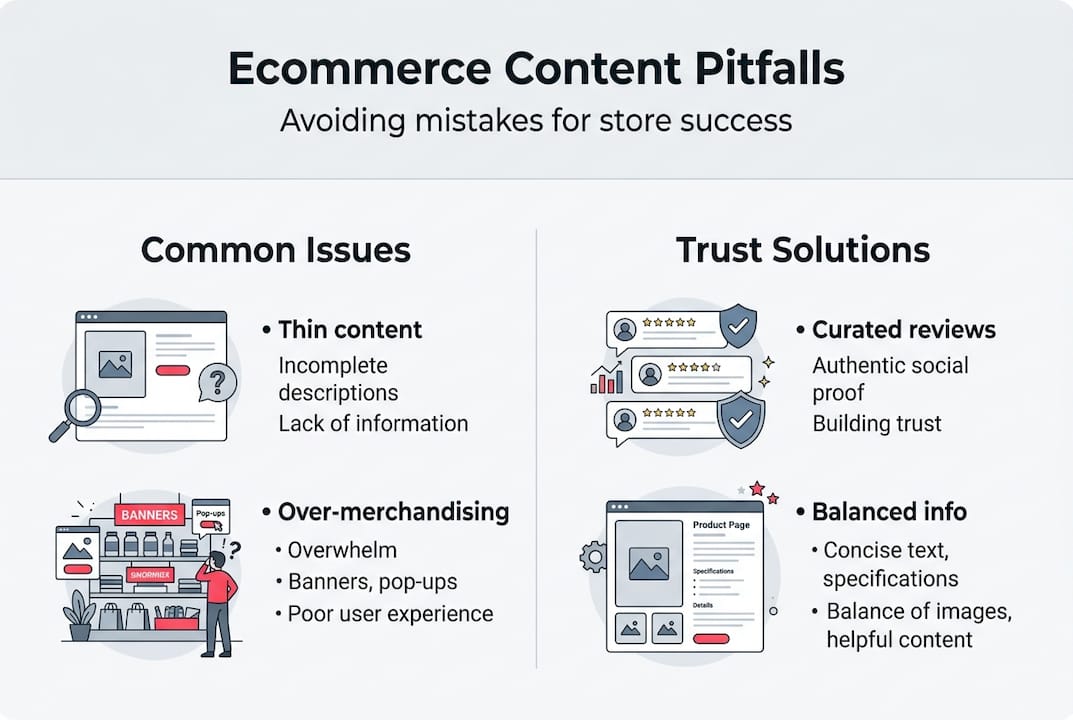
Over-merchandising is a subtler problem. When every page is loaded with promotional banners, urgency timers, and cross-sell widgets, the signal-to-noise ratio collapses. AI-driven personalisation tools, which many stores are now adopting, struggle to surface relevant content when the page is cluttered with competing commercial messages. You end up undermining the very tools you have invested in.
Unmoderated UGC creates trust issues fast. A single misleading review or an unanswered complaint visible on a PDP can cost you conversions at the most critical moment.
Here is a quick checklist of content pitfalls to audit against:
- PDPs with fewer than 150 words of original copy
- Category pages with no descriptive text
- Blog posts that duplicate manufacturer descriptions
- Review sections with no moderation or brand responses
- Promotional overlays that obscure key product information
- No FAQs on high-traffic product or category pages
Improving your retail search visibility starts with fixing these fundamentals before layering on more sophisticated tactics.
Blending AI, personalisation, and human touch for best results
AI is reshaping how ecommerce content is created and delivered. The numbers are striking: AI powers 50% of content by 2025, and augmented reality product experiences reduce returns by 40%. These are not marginal gains.
Here is how the landscape looks for stores using AI-driven content tools:
| Capability | Benefit | Risk if unmanaged |
|---|---|---|
| AI-generated product descriptions | Speed and scale across large catalogues | Generic, off-brand tone |
| Personalised content recommendations | Higher engagement and AOV | Privacy and consent compliance |
| AR product visualisation | Fewer returns, stronger confidence | High implementation cost |
| Automated email content | Consistent lifecycle communication | Loss of brand voice |
AI for hyper-personalisation scales effectively but needs human oversight for authenticity. This is the part most brands get wrong. They automate content creation, remove the editorial review step to save time, and end up publishing descriptions that are technically accurate but feel hollow. Customers notice.
The enterprise content research from the Content Marketing Institute consistently shows that brands with documented strategies and human editorial governance outperform those relying on volume alone.
Pro Tip: Use AI to handle the repetitive, structural work, such as generating first drafts of product descriptions or populating meta fields at scale. Then apply human review to ensure tone, accuracy, and brand consistency. Think of it as AI doing the groundwork and your team adding the character. For a deeper look at how we approach AI-driven personalisation in Magento and Shopify workflows, and how design shapes content performance, both are worth reading alongside this.
Measuring content ROI: What matters for ecommerce leaders
Here is an uncomfortable truth: most ecommerce teams measure the wrong things. Page views and social shares feel good but they do not pay the bills. The metrics that matter are the ones tied directly to revenue.
“Prioritise revenue levers over content output volume. Alignment between content and commercial intent beats scale every time.”
Here is a step-by-step framework for measuring content’s real business value:
- Click-through rate (CTR): Is your content compelling enough to earn the click from search or email? Low CTR means your titles and meta descriptions need work.
- Conversion rate (CVR): Once a visitor lands on a content page, are they moving towards a purchase? Track assisted conversions, not just last-click.
- Average order value (AOV): Does your consideration content (buying guides, bundles, comparisons) influence customers to spend more per transaction?
- Retention rate: Are customers who engage with your post-purchase content (care guides, how-tos, loyalty emails) returning more often?
- Revenue per content piece: Assign revenue attribution to individual pages and campaigns. This tells you which content formats earn their keep.
Prioritise revenue levers such as CTR, CVR, AOV, and retention over content output volume. And the data backs this up: 68% of enterprises rate their marketing as effective when they have a strong documented strategy in place. Strategy alignment is the differentiator, not how much you publish. If improving these metrics is a priority, our guide on how to increase conversions covers practical tactics worth applying alongside your content work.
What most ecommerce brands miss about content’s real value
After working with UK retail brands for over 17 years, we have seen the same pattern repeat itself. Content gets treated as decoration. It is added at the end of a build, written quickly to fill space, and rarely connected to a specific commercial outcome. Then, six months later, the team wonders why organic traffic is flat and conversion rates have not moved.
The uncomfortable truth is that most of your competitors are not getting this right either. That is actually an opportunity. Brands that invest in genuinely useful, well-structured content, mapped to real buyer needs, consistently outperform those chasing volume.
Volume without intent is waste. One well-researched buying guide that answers the exact question your customer is asking at the consideration stage will outperform twenty thin blog posts every time. Automation without oversight produces content that scales mediocrity.
Connect every piece of content to a revenue lever or a specific buyer need. If you cannot articulate why a piece of content exists commercially, it probably should not exist. Getting digital retail right starts with this discipline.
Elevate your ecommerce content with expert support
If this article has surfaced gaps in your current content approach, you are not alone. Most UK retail brands are sitting on significant untapped potential, and the difference between average and excellent often comes down to strategy and execution rather than budget.
At Big Eye Deers, we work with growing and enterprise retail brands to design, build, and support stores that perform commercially. Whether you are on Shopify and need a sharper content and conversion strategy, or you are running a complex Magento store that needs its content architecture overhauled, we bring the experience to make it count. If you want to understand how we work and who we are, meet the Big Eye Deers team and let us have a conversation about what is possible for your store.
Frequently asked questions
What types of content drive the most ecommerce sales?
Educational blogs, buying guides, user-generated reviews, and well-crafted product descriptions drive the most sales when each is aligned to the right buyer journey stage. Matching format to intent is what turns content into a conversion tool.
How can I measure my content’s impact on store performance?
Track conversion rates, AOV, and retention rather than traffic volume alone. Focus on content that leads directly to commercial actions, and attribute revenue to individual pages and campaigns.
Is AI-generated content effective for UK ecommerce sites?
AI content works well for scale and personalisation, but human oversight for authenticity is essential. Without editorial review, automated content can undermine brand trust and produce generic copy that fails to convert.
What is ‘thin content’ and why avoid it in ecommerce?
Thin content lacks substance and fails both search algorithms and buyer confidence. Invest in detailed, useful guides and product pages that genuinely answer customer questions rather than filling space.
Recommended



Adobe Commerce (Magento)
Formerly known as Magento, Adobe Commerce is built for complex catalogues, integrations, and long term growth. We design and develop stable, scalable stores that support demanding eCommerce requirements, including multi-store setups, complex pricing, and Hyva based performance improvements.

Bespoke Build
We design and build custom eCommerce platforms for businesses with complex workflows, integrations, or non standard requirements. Built from scratch around your business needs using Laravel and modern architectures.
Working with brands across the UK from our offices in Cardiff and Exeter, you deal directly with a senior team of designers and developers specialising in Shopify, Magento, WordPress and bespoke eCommerce platforms.
We focus on commercial outcomes. Better conversion rates, strong SEO foundations and eCommerce platforms that continue to improve long after launch.