What is web application security for e-commerce in 2026

Many e-commerce owners treat web application security as a technical afterthought, assuming antivirus software or basic hosting protections suffice. That misconception puts customer data, payment details, and business reputation at serious risk. Security failures don’t just invite hackers; they trigger financial losses averaging £3.8 million per breach, legal penalties, and shattered customer trust. This guide explains what web application security truly involves and outlines practical steps to protect your Magento or Shopify store.
Table of Contents
- What Is Web Application Security And Why It Matters For E-Commerce
- Common Vulnerabilities In E-Commerce Web Applications
- How Platform Type Affects Your Security Responsibilities
- Essential Web Application Security Measures For Your E-Commerce Store
- Enhance Your E-Commerce Security With Expert Magento And Shopify Services
- Frequently Asked Questions
Key takeaways
| Point | Details |
|---|---|
| Web application security protects against cyber threats targeting sensitive customer and payment data in online stores. | Critical for preventing financial losses, legal penalties, and reputational damage. |
| Essential measures include HTTPS encryption, PCI DSS compliance, regular patching, and bot management. | These steps defend against injection attacks, payment skimmers, and automated fraud attempts. |
| Platform type determines security responsibilities: Shopify handles infrastructure; Magento requires full stack management. | Understanding your platform’s security model helps prioritise actions and allocate resources effectively. |
| Common vulnerabilities like SQL injection, XSS, and Magecart skimmers actively target e-commerce sites. | Awareness of specific threats enables proactive defence through proper configuration and monitoring. |
| Admin account protection through multi-factor authentication and rate limiting prevents unauthorised access. | Securing admin panels stops attackers from exploiting weak credentials and gaining control. |
What is web application security and why it matters for e-commerce
Web application security encompasses all measures protecting websites and online applications from cyber threats that exploit code vulnerabilities, server weaknesses, or configuration errors. For e-commerce stores, this means defending every layer where customer data flows: product catalogues, shopping carts, checkout processes, payment gateways, and admin dashboards. Unlike physical retail, your digital storefront faces constant automated attacks testing for weak points.
Online stores become prime targets because they process sensitive information continuously. Payment card details, personal addresses, purchase histories, and login credentials create lucrative opportunities for criminals. A single breach doesn’t just cost money; security incidents lead to legal penalties, customer trust erosion, and lasting reputational damage. The average breach now costs businesses £3.8 million, factoring in incident response, regulatory fines, customer compensation, and lost sales.
Three devastating consequences follow security failures:
- Financial impact from fraud, forensic investigation, legal defence, and compensation claims
- Regulatory penalties under GDPR and PCI DSS for failing to protect customer data
- Permanent reputation damage as customers abandon brands that exposed their information
Security isn’t merely a compliance checkbox or IT department concern. It forms a fundamental business safeguard determining whether customers feel confident completing purchases. Forward-thinking retailers integrate website security tips into their operational foundation rather than treating protection as an optional extra.
“Web application security failures don’t announce themselves with alarms. They silently harvest data, inject malicious code, and undermine customer confidence until discovery forces public disclosure.”
Recognising security as a core business function, not just a technical requirement, shifts perspective from reactive patching to proactive defence. Your store’s security posture directly influences customer lifetime value, conversion rates, and brand equity in 2026’s competitive e-commerce landscape.
Common vulnerabilities in e-commerce web applications
E-commerce platforms face specific attack vectors that criminals exploit repeatedly. Understanding these threats helps you recognise weak points and prioritise defences. The OWASP Top 10 identifies the greatest risks in web application security, providing a framework for assessing your store’s exposure.

Injection attacks, particularly SQL injection, remain devastatingly effective. Attackers insert malicious code into input fields like search boxes or login forms. If your application doesn’t validate input properly, SQL injection and XSS can seriously harm security by exposing databases containing customer records, order histories, and administrative credentials. A successful injection grants attackers direct access to backend systems.
Cross-Site Scripting (XSS) works differently but proves equally dangerous. Criminals inject malicious scripts into web pages viewed by other users. When customers browse product listings or read reviews containing hidden scripts, their browsers execute code that steals session cookies, redirects payments, or captures keystrokes. XSS attacks often go unnoticed because pages appear normal whilst harvesting data in the background.
Payment skimmers, particularly Magecart attacks, specifically target checkout processes. Attackers inject JavaScript that intercepts payment card details as customers type them. These skimmers operate invisibly, sending stolen data to criminal servers whilst allowing transactions to complete normally. Victims remain unaware until fraudulent charges appear, and by then, thousands of cards may be compromised.
Automated bot attacks pose a growing threat:
- Credential stuffing attempts using stolen username/password combinations from other breaches
- Inventory hoarding bots that grab limited stock, disrupting genuine sales
- Price scraping competitors systematically copying your catalogue and pricing
- Form spam overwhelming contact systems and degrading performance
| Vulnerability Type | Attack Method | Primary Risk |
|---|---|---|
| SQL Injection | Malicious database queries via input fields | Complete database access and data theft |
| Cross-Site Scripting | Script injection into pages viewed by users | Session hijacking and credential theft |
| Payment Skimmers | JavaScript interception at checkout | Direct payment card compromise |
| Credential Stuffing | Automated login attempts with stolen credentials | Account takeover and fraud |
Platform choice affects security responsibilities differently, but vulnerabilities exist across all systems. Shopify’s managed infrastructure reduces some risks, yet merchants remain responsible for configuration and data security. Magento’s flexibility introduces complexity requiring vigilant patch management and server hardening.
Recognising these common threats allows you to assess your current defences objectively. Most breaches exploit known vulnerabilities that proper configuration and timely updates would prevent. The question isn’t whether attacks will occur, but whether your defences stop them before damage occurs.
How platform type affects your security responsibilities
Your e-commerce platform fundamentally determines who manages security and where your efforts focus. Understanding this division prevents dangerous gaps where critical protections fall through cracks between assumed and actual responsibilities.
Shopify operates as Software as a Service (SaaS), meaning Shopify handles core security including server infrastructure, platform updates, database protection, and DDoS mitigation. Shopify merchants benefit from enterprise-grade security without managing servers. However, you remain responsible for admin account security, app permissions, customer data handling, and checkout configuration. Choose weak passwords or install malicious apps, and Shopify’s infrastructure security won’t prevent breaches.
Magento presents a contrasting model. Whether using Magento Open Source or Adobe Commerce, merchants must secure the entire stack including hosting servers, database systems, application code, installed extensions, and theme files. This complete ownership offers flexibility but demands comprehensive security knowledge and ongoing vigilance.
Key Magento security responsibilities include:
- Changing the default admin URL from /admin to something obscure
- Applying security patches immediately upon release
- Hardening server configurations and restricting file permissions
- Vetting third-party extensions before installation
- Implementing Web Application Firewalls and intrusion detection
- Regularly scanning for malware and unauthorised code changes
Shopify merchants should prioritise:
- Enforcing strong password policies and multi-factor authentication
- Carefully reviewing app permissions before installation
- Limiting staff access to only necessary admin functions
- Monitoring third-party integrations for security updates
- Using Shopify’s built-in fraud analysis tools
- Ensuring custom theme code follows security best practices
Pro Tip: Regardless of platform, enable two-factor authentication for all admin accounts immediately. This single step blocks most credential-based attacks even when passwords leak.
Platform differences extend beyond security into performance, customisation, and scalability. Shopify simplifies security management, ideal for merchants wanting to focus on sales rather than server administration. Magento suits businesses needing custom security implementations, advanced B2B features, or specific compliance requirements.
Neither platform offers perfect security by default. Both require active management, informed decisions about extensions and apps, and understanding where your responsibilities begin. The shared responsibility model means platform security proves only as strong as your weakest configuration choice.
Essential web application security measures for your e-commerce store
Protecting your store requires implementing multiple defensive layers. No single measure provides complete protection; effective security combines several proven practices working together.
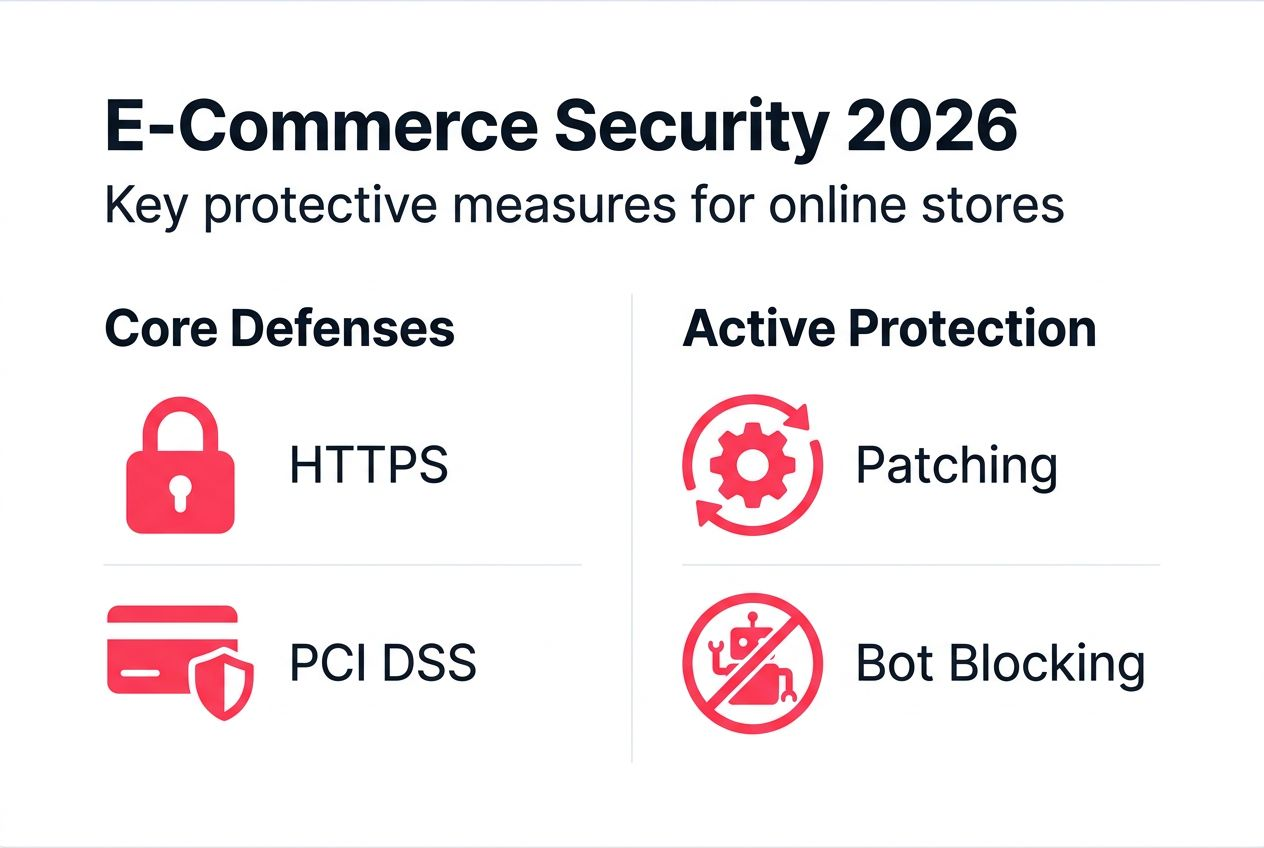
HTTPS encryption is non-negotiable for any site handling sensitive data. Valid SSL/TLS certificates encrypt information travelling between customer browsers and your server, preventing interception. Search engines penalise non-HTTPS sites, and modern browsers display alarming warnings that destroy conversion rates. Ensure certificates remain current and cover all subdomains.
PCI DSS compliance governs how you handle payment card data. Compliance requirements vary by transaction volume and whether you store, process, or transmit card details. Using compliant payment gateways like Stripe or PayPal shifts much compliance burden to processors, but you still must maintain secure environments and pass periodic assessments. Non-compliance risks losing payment processing entirely.
Regularly applying security patches is the single most important preventative step. Attackers exploit known vulnerabilities within hours of public disclosure. Delayed patching leaves your store defenceless against automated scans seeking unpatched systems. For Magento, this means monitoring Adobe’s security centre and applying updates immediately. Detailed guidance on Magento security patch importance and comprehensive patching procedures helps maintain current protections.
Content Security Policy (CSP) and Subresource Integrity (SRI) defend against injected scripts. CSP restricts which domains can load JavaScript, preventing unauthorised code execution. SRI verifies that loaded files match expected cryptographic hashes, blocking tampered libraries. Implementing these browser security features stops many XSS and skimmer attacks before execution.
Login page protection requires multiple defences working simultaneously:
- Rate limiting restricts login attempts, stopping brute force attacks
- Multi-factor authentication adds verification beyond passwords
- CAPTCHA challenges distinguish humans from automated bots
- IP blocking automatically bans addresses showing attack patterns
- Login attempt monitoring alerts administrators to suspicious activity
Bot management solutions detect and block automated threats without disrupting legitimate customers. Advanced bots mimic human behaviour, defeating simple CAPTCHA tests. Sophisticated bot detection analyses browsing patterns, device fingerprints, and interaction timing to identify non-human traffic accurately.
Pro Tip: Two-factor authentication significantly reduces unauthorised access risk even when passwords leak in third-party breaches. Enable it universally for admin accounts and offer it as an option for customer accounts.
| Security Measure | Primary Benefit | Implementation Complexity |
|---|---|---|
| HTTPS/SSL | Encrypts data in transit | Low (automated certificates available) |
| PCI DSS Compliance | Legal payment card handling | Medium (depends on processing model) |
| Regular Patching | Closes known vulnerabilities | Medium (requires monitoring and testing) |
| CSP and SRI | Prevents script injection | High (requires careful configuration) |
| Multi-Factor Authentication | Blocks credential-based attacks | Low (built into most platforms) |
| Bot Management | Stops automated fraud | Medium (may require third-party service) |
These measures form your security foundation. Implementing them systematically transforms your store from a soft target into a hardened system that repels common attacks automatically. Security investment pays dividends through prevented breaches, maintained customer trust, and uninterrupted trading.
Enhance your e-commerce security with expert Magento and Shopify services
Implementing comprehensive security requires expertise spanning platform architecture, threat intelligence, and regulatory compliance. Professional services accelerate your security posture whilst ensuring nothing falls through gaps.

Our Magento web design services integrate security from initial architecture through ongoing monitoring. We implement Sansec malware detection, configure Content Security Policies, harden admin access, and maintain proactive patch management. For Shopify merchants, our UK Shopify agency ensures secure app selection, proper permission scoping, and configuration aligned with payment security standards. Security combines with performance optimisation and conversion strategy through our comprehensive e-commerce approach, delivering stores that protect customers whilst driving commercial growth.
Frequently asked questions
What is the difference between SaaS and self-hosted e-commerce platforms regarding security?
SaaS platforms like Shopify manage infrastructure security including servers, databases, and core application updates, reducing merchant technical burden. Self-hosted platforms like Magento require merchants to secure the entire technology stack from server configuration through application patching. Both models demand strong admin account protection and careful third-party extension management, but self-hosted merchants carry broader responsibility for underlying infrastructure.
Why is HTTPS essential for e-commerce websites?
HTTPS encrypts all data transmitted between customer browsers and your server, preventing interception of payment details, passwords, and personal information. Without HTTPS, attackers on shared networks can read transmitted data in plain text. Modern browsers display prominent security warnings on non-HTTPS sites, destroying customer confidence and conversion rates before they reach checkout.
What role does PCI DSS play in e-commerce security?
PCI DSS establishes mandatory security standards for any business handling payment card data, with compliance requirements varying by transaction volume. Using compliant payment processors reduces your compliance scope, but you must still maintain secure environments and pass assessments. Non-compliance risks substantial fines and losing payment processing capabilities entirely, effectively shutting down online sales.
How does multi-factor authentication improve account security?
Multi-factor authentication requires users to provide two separate verification methods, typically a password plus a temporary code from a mobile device. Even if attackers steal passwords through phishing or data breaches, they cannot access accounts without the second factor. This simple measure blocks over 90% of credential-based attacks targeting admin panels and customer accounts.
What security measures protect payment data during checkout?
Secure payment processing combines HTTPS encryption during transmission, PCI DSS compliant payment gateways that tokenise card details, and Content Security Policies preventing script injection. Never store complete card numbers on your server; use tokenisation where payment processors store sensitive data whilst you retain only transaction references. Regular security scanning detects payment skimmers before they compromise customer cards.
Recommended



Adobe Commerce (Magento)
Formerly known as Magento, Adobe Commerce is built for complex catalogues, integrations, and long term growth. We design and develop stable, scalable stores that support demanding eCommerce requirements, including multi-store setups, complex pricing, and Hyva based performance improvements.

Bespoke Build
We design and build custom eCommerce platforms for businesses with complex workflows, integrations, or non standard requirements. Built from scratch around your business needs using Laravel and modern architectures.
Working with brands across the UK from our offices in Cardiff and Exeter, you deal directly with a senior team of designers and developers specialising in Shopify, Magento, WordPress and bespoke eCommerce platforms.
We focus on commercial outcomes. Better conversion rates, strong SEO foundations and eCommerce platforms that continue to improve long after launch.