Why hybrid ecommerce models matter for UK retailers
TL;DR:
- Hybrid ecommerce unifies customer data, inventory, and pricing across channels, unlike multichannel and omnichannel models. It enhances customer experience by enabling continuous journeys, reducing friction, and supporting real-time personalization. Operational and strategic advantages include increased profitability, resilience, and smarter marketing through integrated data and control.
Many UK retailers assume that listing products across multiple channels automatically translates to better sales and happier customers. It doesn’t. Why hybrid ecommerce models matter goes far deeper than presence on multiple platforms: it’s about whether those platforms share data, recognise the same customer, and deliver a continuous experience regardless of where the shopper chooses to engage. This article unpacks what hybrid ecommerce genuinely involves, where it differs from multichannel and omnichannel thinking, and why getting it right is increasingly the difference between growing and stagnating in the current UK retail climate.
Table of Contents
- What is a hybrid ecommerce model and how does it differ from multichannel and omnichannel
- Why seamless customer journeys and context continuity are critical
- Operational advantages of hybrid ecommerce models
- Hybrid marketing approaches: combining automation and control for sustainable growth
- Why hybrid ecommerce models improve business resilience and growth in volatile markets
- Why focusing on customer continuity, not just channels, is the true competitive edge
- How Big Eye Deers helps UK retailers build and optimise hybrid ecommerce models
- Frequently asked questions
Key Takeaways
| Point | Details |
|---|---|
| Customer journey continuity | Hybrid ecommerce ensures customers experience a seamless, connected journey without losing preferences or progress across channels. |
| Operational efficiency | Integrating hybrid AI and multi-cloud systems optimises backend processes, reducing errors and increasing profitability. |
| Marketing balance | Running hybrid marketing campaigns balances automation with control, improving customer acquisition and ROI. |
| Business resilience | Hybrid models combining B2B and B2C reduce revenue volatility and provide strategic advantages in uncertain markets. |
| Focus on continuity | The key to hybrid ecommerce success is recognising customers continuously and simplifying operations, not just adding channels. |
What is a hybrid ecommerce model and how does it differ from multichannel and omnichannel
To understand the importance of hybrid ecommerce, you first need to be clear on what it actually is, because the term gets conflated with multichannel and omnichannel ecommerce constantly, and they are not the same thing.
Multichannel means selling across several independent channels: your website, Amazon, a physical store, perhaps a social shop. Each channel operates in its own silo. A customer who browses your website and then walks into your store is effectively a stranger again. There’s no shared data, no unified basket, no memory.
Omnichannel takes a step forward by integrating channels to create a smoother experience. But integration at the front end doesn’t always mean unification at the back end. Many retailers achieve a degree of omnichannel polish — a consistent brand voice, shared promotions — while still running disconnected inventory systems or duplicate customer records underneath.
Hybrid ecommerce goes further. As Azilen explains, hybrid ecommerce unifies customer context and synchronises inventory and pricing across all channels, which is precisely what distinguishes it from fragmented multichannel systems. It’s not just about where you sell. It’s about whether all those selling environments share a single version of the truth about your customer, your stock, and your pricing.
Here’s a quick comparison to make this concrete:
| Feature | Multichannel | Omnichannel | Hybrid ecommerce |
|---|---|---|---|
| Multiple sales channels | ✓ | ✓ | ✓ |
| Consistent branding | Partial | ✓ | ✓ |
| Shared customer data | ✗ | Partial | ✓ |
| Synchronised inventory | ✗ | Partial | ✓ |
| Unified pricing across channels | ✗ | Partial | ✓ |
| Continuous customer journey | ✗ | ✗ | ✓ |
What hybrid ecommerce models deliver that the others don’t:
- A single customer profile accessible across every touchpoint
- Real-time inventory visibility whether you’re online, in a warehouse, or in a shop
- Pricing and promotional consistency that prevents customers finding better deals on a different channel to the one you’re actively promoting
- Journey continuity: a customer who adds to their basket on mobile can complete the purchase in-store without starting again
Why seamless customer journeys and context continuity are critical
Understanding hybrid models’ technical makeup sets the stage for why continuity enhances customer satisfaction and drives sales. And the stakes here are higher than most retailers appreciate.
Customers today do not experience your business in a linear way. They might research on Instagram, price-check on desktop, visit the store to touch the product, and then purchase via your app on the way home. Every time they have to reintroduce themselves, repeat a preference, or start a basket from scratch, you’ve created friction. Friction costs you conversions. For high-consideration purchases like furniture, electronics, or clothing where fit matters, this friction is particularly damaging.

Preserving cart context and shopping history across channels is one of the clearest ways hybrid ecommerce improves revenue. When a customer feels recognised, they trust you more. When they trust you more, they’re more likely to complete a purchase and return.
Chris Holyland, Director of Digital and Omnichannel at Currys, makes this point plainly: omnichannel only works if the retailer recognises the customer at every stage of the journey, rather than making them start over at each touchpoint. Currys is a brand operating at scale in the UK, and even they are focused on this as a core operational challenge.
Here’s where hybrid ecommerce models deliver customer experience advantages most clearly:
- Abandoned basket recovery becomes significantly more effective when the basket is device-agnostic and persists across sessions
- In-store staff can access a customer’s browsing and purchase history to offer genuinely useful guidance rather than starting from zero
- Personalised recommendations at checkout or via email are more accurate because they draw on the full picture of customer behaviour, not just one channel’s data
- Returns and exchanges are smoother because both online and in-store teams share the same order history
Pro Tip: If you’re starting to build this continuity, customer identity is your foundation. Encourage account creation at every touchpoint, and use that account data to feed personalisation across your CRM, email, and in-store systems.
Operational advantages of hybrid ecommerce models
Beyond customer-facing benefits, hybrid ecommerce models transform operations and profitability through smart integrations and cloud strategies.
The operational case for hybrid models is compelling, and increasingly backed by data. A study published in Scientific Reports found that hybrid AI-powered ecommerce frameworks improve profitability by 6.3% and produce significant gains in customer retention metrics. That’s not a marginal improvement. For a retailer turning over £5 million, a 6.3% profitability gain is meaningful money.
The operational benefits compound when you consider what a unified back end actually prevents:
- Overselling: When inventory is synchronised in real time, you stop selling stock that doesn’t exist
- Manual reconciliation: Fewer disconnected systems means fewer hours spent matching records across platforms
- Fulfilment errors: A unified order management system routes orders to the right warehouse or store without human intervention
- Pricing inconsistencies: Centralised pricing rules prevent a product being sold cheaper on one channel than another, protecting margins
AI-driven hybrid systems are increasingly central to this operational picture. Examples of AI in ecommerce illustrate how dynamic pricing, demand forecasting, and automated customer service are all made more effective when the underlying data is clean and unified.
On the infrastructure side, multi-cloud B2B commerce platforms reduce reliance on any single vendor, improve uptime, and make it easier to scale during peak trading periods without performance degradation. For UK retailers heading into peak events like Black Friday or the Christmas trading period, that resilience is not optional.
| Operational challenge | Without hybrid model | With hybrid model |
|---|---|---|
| Inventory accuracy | Per-channel discrepancies | Real-time unified view |
| Fulfilment speed | Manual routing and delays | Automated and optimised |
| Pricing control | Inconsistent across channels | Centralised rules engine |
| Customer data quality | Duplicate records and gaps | Single unified profile |
Pro Tip: Before investing in AI or advanced integrations, build your single source of truth first. Product data, pricing, and customer records need to be clean and centralised before any AI layer can add reliable value on top of them.
Hybrid marketing approaches: combining automation and control for sustainable growth
Marketing strategies benefit equally from hybrid models, balancing automation and manual control to deliver better reach and efficiency.
Google’s Performance Max campaigns are a good illustration of this. Performance Max uses machine learning to discover new customers across Search, Shopping, YouTube, Display, and Gmail simultaneously. Run in isolation, it works well for prospecting. But it will also pursue traffic you’ve already converted, and it can cannibalise your Standard Shopping campaigns, where you have precise control over which products appear for which queries.
The hybrid campaign approach of running Performance Max alongside Standard Shopping prevents this inefficient budget competition and improves overall results. In practice, this means:
- Performance Max handles broad discovery: new audiences, interest-based signals, and cross-channel reach
- Standard Shopping handles high-intent, high-margin traffic: best-selling SKUs, branded searches, and known purchase-ready queries
- Campaign segmentation by user intent means your budget is doing different jobs efficiently rather than competing with itself
- Active management of both campaign types is essential. Automation without oversight leads to wasted spend and eroded margins
This mirrors the broader principle behind hybrid marketing strategy: don’t choose between automation and control. Combine them deliberately and manage the boundaries actively.
Why hybrid ecommerce models improve business resilience and growth in volatile markets
Finally, hybrid ecommerce models strengthen long-term business resilience and innovation through diversification. This is a dimension that doesn’t get nearly enough attention.
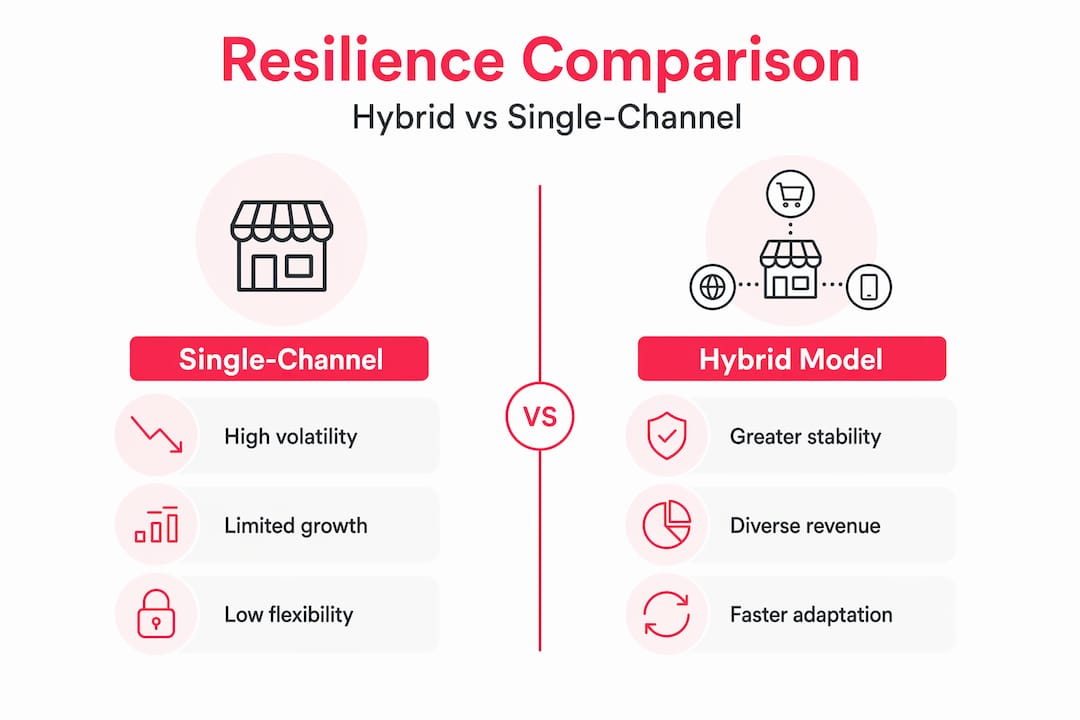
Most ecommerce businesses are dangerously dependent on a single revenue stream. Purely DTC brands live and die by consumer demand cycles. Purely wholesale brands are exposed to retailer consolidation and margin pressure. Hybrid commerce models that combine B2B and B2C show 37% lower revenue volatility during economic downturns compared with single-channel competitors. That’s a structural advantage, not a marginal one.
The benefits of running hybrid B2B and B2C operations simultaneously go beyond just risk reduction:
- Richer data: B2B buying patterns inform product development and inventory planning in ways that pure DTC data rarely can
- Pricing intelligence: Serving both markets gives you a clearer picture of where your true price elasticity sits
- Competitive barriers: Operational infrastructure built to serve both B2B and B2C is significantly harder for a competitor to replicate than a single-channel setup
- Innovation fuel: Insights from one market consistently surface opportunities in the other
| Resilience factor | Single-channel model | Hybrid B2B and B2C model |
|---|---|---|
| Revenue volatility | High, cycle-dependent | Lower, balanced across markets |
| Data richness | Narrow and siloed | Broad and cross-market |
| Competitive advantage | Easier to replicate | Structurally harder to match |
| Innovation rate | Slower, limited signals | Faster, richer insight pool |
Why focusing on customer continuity, not just channels, is the true competitive edge
Here’s our honest view after working with UK retailers across Magento and Shopify for over 17 years: the word “hybrid” has become a comfort word. Retailers hear it, nod, and then go back to managing five disconnected systems and calling it done.
The genuine advantage of hybrid ecommerce is not the number of channels you operate. It’s whether your customer ever has to repeat themselves. That’s the test. Can your in-store team see what a customer researched online last week? Can your email platform trigger a follow-up based on an in-store interaction? Can your support team resolve a complaint without asking which channel the purchase was made through? If the answer to any of those is no, you’re not running a hybrid model. You’re running parallel silos with a shared logo.
Omnichannel only truly works when the retailer recognises the customer at every stage of the journey and offers proactive help rather than reactive damage control. That requires deliberate architectural decisions, not just platform investment.
We also see too many retailers chasing AI-powered personalisation before they’ve sorted the basics. AI adds genuine value, but only when it’s orchestrated on top of clean, unified data. Bolt an AI recommendation engine onto a fragmented data model and you’ll serve irrelevant suggestions with great confidence.
The customer-centric design principles we apply in our UX work at Big Eye Deers start from journey mapping, not technology selection. Which moments in the customer journey currently ask them to repeat themselves? Fix those first. Then layer in automation and AI. The retailers we see pulling ahead aren’t necessarily running the most sophisticated tech stacks. They’re running the most joined-up ones, where the omnichannel marketing experience feels effortless precisely because the operational work is invisible.
Pro Tip: Build a simple continuity audit. List every point in your customer journey where data does not follow the customer from one touchpoint to the next. Each gap is a conversion risk and a loyalty drain. Prioritise fixing the highest-traffic gaps first.
How Big Eye Deers helps UK retailers build and optimise hybrid ecommerce models
If this article has clarified why hybrid ecommerce models matter and what genuine implementation involves, the next question is practical: where do you start, and who can help you get there?
At Big Eye Deers, we design, build, and support hybrid ecommerce platforms for growing and enterprise UK retailers through our Magento web design services and Shopify ecommerce agency offer. Our work spans custom catalogue builds, ERP integrations, tiered B2B pricing, multi-store setups, and AI-powered product discovery using Klevu. We use Figma to map customer journeys before a line of code is written, ensuring every architecture decision is grounded in commercial reality. Our team in Cardiff and Exeter brings over 17 years of hands-on experience to retailers who are serious about building ecommerce infrastructure that lasts.
Frequently asked questions
What exactly is a hybrid ecommerce model?
A hybrid ecommerce model unifies online, mobile, and in-store channels into a continuous experience by synchronising customer data, inventory, and pricing, preventing the fragmented journeys that lose customers between touchpoints.
How does a hybrid model improve customer experience compared to multichannel?
By preserving customer context such as saved baskets and preferences across all touchpoints, hybrid models deliver continuous journeys that reduce abandoned purchases and build trust. As Currys’ omnichannel director notes, customers expect to be recognised at every stage, not made to start over.
Why are hybrid marketing campaigns more effective?
Hybrid campaign strategies that combine Performance Max for discovery with Standard Shopping for high-intent traffic segment budgets by user intent, balancing automation’s reach with precise manual control and improving overall ROI.
How do hybrid ecommerce models help business resilience?
They combine B2B and B2C revenue streams, and dual revenue stream businesses show 37% lower volatility during economic downturns while generating richer cross-market data that supports faster innovation and stronger competitive positioning.
Recommended



Adobe Commerce (Magento)
Formerly known as Magento, Adobe Commerce is built for complex catalogues, integrations, and long term growth. We design and develop stable, scalable stores that support demanding eCommerce requirements, including multi-store setups, complex pricing, and Hyva based performance improvements.

Bespoke Build
We design and build custom eCommerce platforms for businesses with complex workflows, integrations, or non standard requirements. Built from scratch around your business needs using Laravel and modern architectures.

Working with brands across the UK from our offices in Cardiff and Exeter, you deal directly with a senior team of designers and developers specialising in Shopify, Magento, WordPress and bespoke eCommerce platforms.
We focus on commercial outcomes. Better conversion rates, strong SEO foundations and eCommerce platforms that continue to improve long after launch.